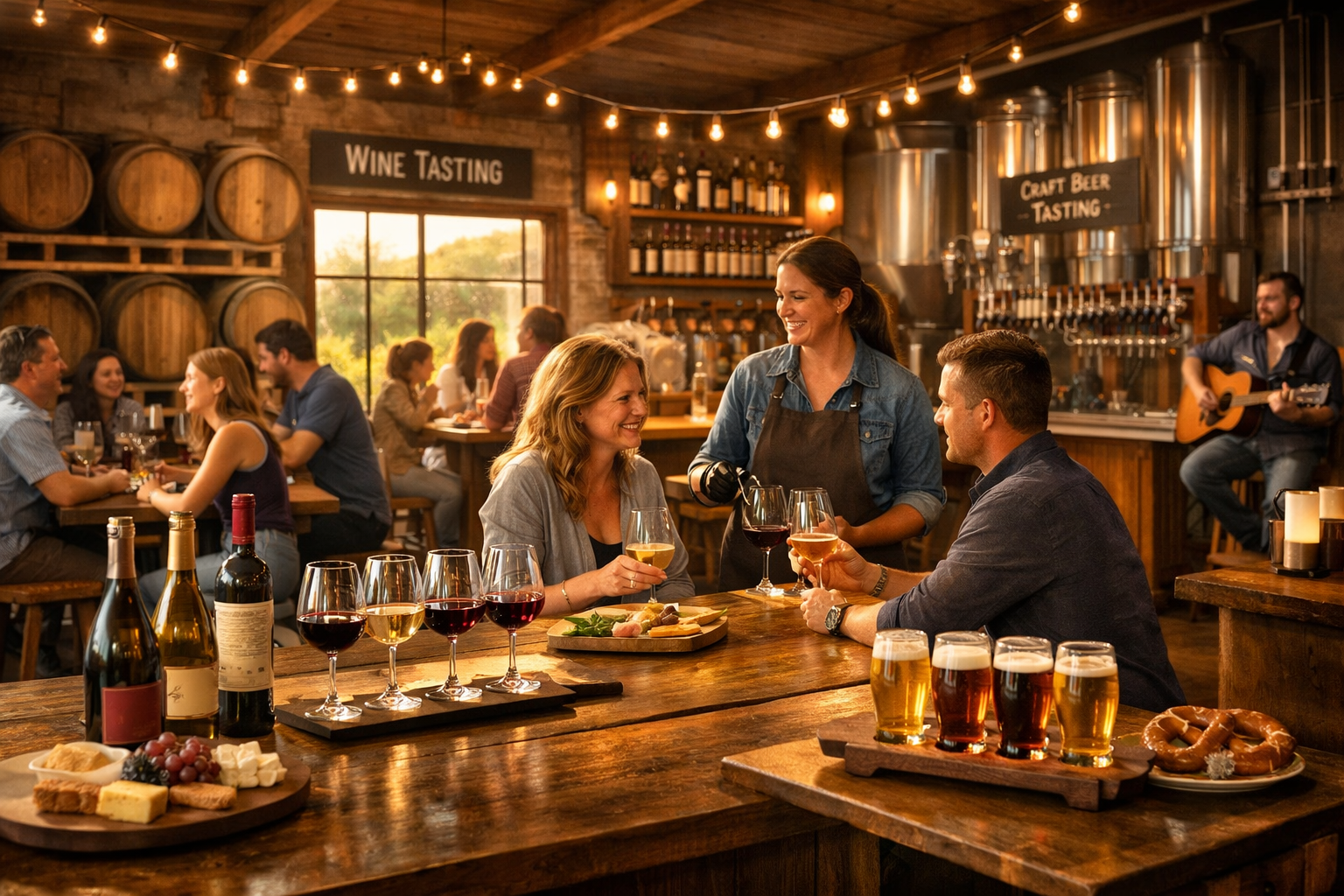
Across both wine and beer, the same paradox is emerging: the broader beverage alcohol market is softening, yet hospitality‑driven tasting rooms—those built around onsite experiences, community, and human connection—are outperforming the industry at large. The 2026 Wine Business Monthly Tasting Room Survey and the Brewers Association’s 2025 New Brewer Industry Overview tell remarkably similar stories from opposite sides of the beverage aisle.
Despite declines in overall consumption, rising costs, and a national shift toward staying home, tasting rooms remain one of the few places where producers are still growing revenue, strengthening loyalty, and attracting new audiences.
The data from both the wine and beer sectors points to a shared conclusion: producers who invest in hospitality are outperforming those who rely primarily on distribution. Experience‑driven tasting rooms—whether winery, taproom, or brewpub—have become the most resilient revenue engines in an era defined by declining alcohol consumption and rising consumer inertia. The next two years will reward operators who treat hospitality not as an accessory but as a core business strategy. This includes designing tasting rooms that function as social anchors, integrating digital tools that streamline service without replacing human connection, and building hybrid models that blend onsite experiences with digital engagement and events. Partnerships with local businesses, from restaurants to wellness providers, are becoming essential traffic drivers, and the wineries and breweries that adopt tiered offerings are best positioned to welcome younger consumers who are price‑sensitive but experience‑motivated.
Within this broader shift, several tactical priorities are emerging. Experience‑driven tasting rooms—those that offer layered, intentional hospitality—consistently outperform the market because they give consumers a reason to leave home. Hybrid models that combine onsite tasting, digital marketing, and event programming help producers reach audiences across multiple touchpoints, extending the relationship beyond a single visit. Local partnerships amplify visibility and create shared value, especially in regions where tourism has softened. And tiered offerings, whether lower‑priced tastings or flexible membership structures, help wineries and breweries meet younger consumers where they are without diluting brand identity.
These trends reflect a simple truth: the gravity of the couch is strong, but the pull of a well‑designed hospitality experience is stronger. The businesses that succeed in 2026–2027 will be those that pair operational efficiency with human warmth, use technology to enhance—not automate—the guest journey, and create spaces that feel like community hubs rather than retail outlets. In this environment, hospitality is no longer a supplement to production; it is the strategic center of the modern beverage business.
1. The Macro Picture: Declines Everywhere Except Hospitality
Beer: On‑Premise Shrinks, But Brewery Taprooms Shine
According to NielsenIQ’s CGA dataset, 2025 was another contraction year for beer in bars and restaurants:
- Beer volume at eating establishments: –8%
- Craft beer volume: –10%
- Beer volume at drinking establishments: –6%
- Craft beer volume: –9%
- Combined draft volume: –5% overall, –10% for craft
Yet onsite‑focused craft breweries bucked the trend:
- Brewpubs (food + onsite sales) were down only 1.7%, the best performance of any craft segment.
- 44% of brewpubs increased production—five points above the craft average.
- Taprooms (onsite sales, limited food) were down 3.9%, still outperforming the broader market.
- Both models had the lowest closure‑to‑opening ratio in craft: 1.4:1.
The data is clear: the more a brewery leans into hospitality, the better it performs.
Wine: Tasting Rooms Outperform a Declining Category
The wine industry is facing its own headwinds—declining visitation, rising costs, and a generational shift in drinking habits. Yet tasting rooms remain the strongest DTC channel:
- Median tasting room order value in 2025: $90 nationally
- Napa: $270, Sonoma: $128, Central Coast: $100
- Wine club acquisition rates remain strong in many regions (e.g., 25% in the Pacific Northwest and East of Rockies)
- 73% of wineries now partner with restaurants, hotels, wellness businesses, and other wineries to drive traffic
Even as “decreased tasting room visitation” was the #1 obstacle reported for 2025, tasting rooms still outperformed wholesale and retail channels by a wide margin.
2. Why Hospitality Works: Experience Outweighs Convenience
Both industries are fighting the same cultural shift: Americans are going out less.
- Full‑service restaurants now get 35.4% of traffic from off‑premise (up from 12.1% in 2019).
- Limited‑service restaurants jumped from 74.1% to 89.9% off‑premise.
- Americans aged 15–29 spend 45% more time alone than in 2010 (BLS Time Use Survey).
In a world where consumers can order anything from their couch, the only reason to leave home is for an experience worth leaving home for.
That’s where tasting rooms excel.
Craft breweries
Taprooms and brewpubs succeed because they offer:
- Community
- Social connection
- A “third place” outside home and work
- Human‑centered service
- A curated, local identity
As the Brewers Association notes, the most successful operators pair personalized hospitality with technology that reduces friction—online reservations, digital menus, streamlined ordering—without making guests feel like they’re being served by robots.
Wineries
Wine tasting rooms are leaning into:
- Tiered tasting experiences
- Lower‑priced entry points for younger consumers
- Events and activities
- Digital marketing and storytelling
- New facilities and experiential upgrades
In the 2026 survey, wineries reported that the most effective ways to attract younger drinkers were:
- Social/digital marketing
- Events and activities
- Experiences and new facilities
Lowering fees helped, but experience design mattered more.
3. The Common Thread: Hospitality as a Revenue Engine
Across both wine and beer, hospitality‑driven businesses share several advantages:
Higher margins
Onsite sales—whether a pint or a tasting flight—deliver the strongest per‑unit profitability.
Stronger loyalty
Wine club signups, mug clubs, memberships, and repeat visits all originate in the tasting room.
Better storytelling
Producers can explain their craft, their values, and their process directly to consumers.
Community building
Tasting rooms function as social hubs, something digital commerce cannot replicate.
Resilience against market declines
Even when overall consumption drops, consumers still seek meaningful experiences.
4. The Strategic Imperative for 2026–2027
The data from both industries points to the same conclusion: Producers who invest in hospitality will outperform those who rely on distribution alone.
The next two years will reward:
- Experience‑driven tasting rooms
- Hybrid models (onsite + digital + events)
- Partnerships with local businesses
- Tiered offerings that welcome younger consumers
- Technology that enhances—not replaces—human service
- Food programs (even limited ones) that extend dwell time and increase spend
The gravity of the couch is real. But tasting rooms—wine and beer alike—are proving that consumers will still get up, go out, and engage when the experience is worth it.