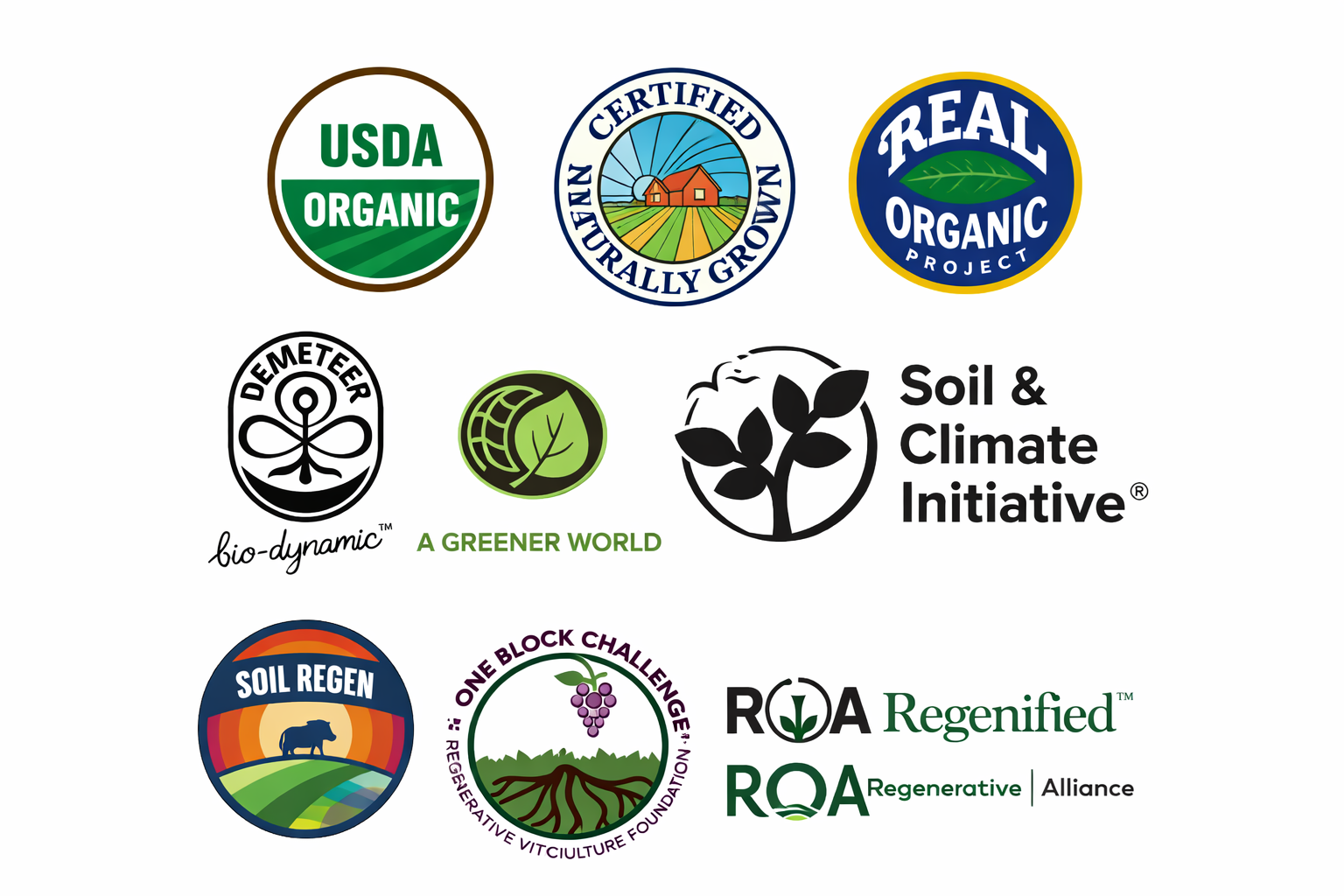
Growers and consumers navigate a complex ecosystem of agricultural certifications — each with its own standards, inspection protocols, and philosophical foundations. What does each certification mean? How do they differ? Some focus strictly on inputs, others on ecological outcomes, and even more incorporate social or animal‑welfare criteria. What follows is an overview of the major certifications used in organic, biodynamic, and regenerative agriculture.
Overview
| Program | Scope & Focus | Verification Model | Core Principles |
|---|---|---|---|
| USDA Organic | National organic standard for crops & livestock | Third‑party audit under federal regulation | No synthetic fertilizers/pesticides, no GMOs, 3‑year transition |
| Certified Naturally Grown | Community‑based alternative to USDA Organic | Peer review inspections | Small‑farm oriented; aligns closely with USDA Organic rules |
| Real Organic Project | Add‑on label reinforcing soil‑based organic farming | Annual inspection | Soil‑grown crops; excludes hydroponics; pasture‑based livestock |
| Demeter Biodynamic | Whole‑farm ecological system | Third‑party audit | Biodiversity, closed nutrient cycles, biodynamic preparations |
| A Greener World – Regenerative Certified | Regenerative outcomes across crop & livestock systems | Third‑party audit | Soil health, biodiversity, measurable ecological improvement |
| Soil & Climate Initiative | Outcome‑based regenerative verification | Annual measurement & reporting | Continuous improvement in soil function & climate impact |
| Regenerative Organic Certified (ROA) | Regenerative organic agriculture | Tiered certification (Bronze–Gold) | Soil health, animal welfare, social fairness |
| Regenified™ | Regenerative performance standard | Tiered verification (Levels 1–6) | Six soil‑health principles; whole‑system outcomes |
| Soil Regen | Regenerative agronomy consulting & verification | Data‑driven assessment | Soil testing, biological improvement, farmer profitability |
| Regenerative Viticulture Foundation | Regenerative grape‑growing & education | Voluntary participation | Soil restoration, biodiversity, One Block Challenge™ |
| Land to Market | Regenerative sourcing for food, fiber & leather | Outcome-based verification using Ecological Outcome Verification (EOV) | Soil health, biodiversity, ecosystem function measured annually |
| Fibershed Climate Beneficial™ | Regenerative fiber & textile systems | Practices verified through carbon‑farm planning | Soil carbon drawdown, climate‑positive land stewardship |
| Ethos™ | Regenerative supply‑chain transparency | Digital verification & traceability platform | Outcome tracking, soil‑health metrics, producer‑level data integrity |
Organic Certifications

USDA Organic (National Organic Program)
The USDA Organic seal represents the United States’ federal regulatory standard for organic production. It prohibits synthetic fertilizers, most synthetic pesticides, sewage‑sludge‑based amendments, and genetically modified organisms. Land must undergo a three‑year transition period before certification. Farms maintain an Organic System Plan (OSP) and undergo annual third‑party inspections.
USDA Transitional Organic
This designation supports farms during the required three‑year transition to full USDA Organic status. It does not permit organic labeling on products but verifies that land is under compliant organic management. Transitional certification helps growers communicate progress to buyers and lenders.

Certified Naturally Grown (CNG)
CNG is a peer‑reviewed alternative to USDA Organic designed for small, direct‑market farms. Standards closely mirror USDA Organic, but inspections are conducted by fellow farmers rather than accredited auditors. CNG emphasizes transparency and community‑based verification.

Real Organic Project (ROP)
ROP is an add‑on label for USDA‑certified farms that meet additional soil‑based requirements. It excludes hydroponic production and confinement livestock systems, reinforcing traditional organic principles centered on soil health and ecological integration.
Biodynamic Certification

Demeter Certified Biodynamic
Demeter is the global biodynamic standard and one of the oldest ecological farming certifications. It builds on organic requirements and adds whole‑farm ecological criteria, mandatory biodiversity areas, limits on imported fertility, and use of biodynamic preparations. Certification requires annual inspections and licensing fees based on gross sales.
Regenerative Certifications

Regenerative Organic Certified® (ROC)
ROC is administered by the Regenerative Organic Alliance and layers regenerative requirements on top of USDA Organic. It evaluates farms across three pillars: soil health, animal welfare, and social fairness. Practices include cover cropping, reduced tillage, and verified labor standards. ROC offers three tiers—Bronze, Silver, and Gold—based on performance. See also Regenerative Farming at Grgich Hills Estate and Domaine Bousquet, GAIA, and Regenerative Farming.

Regenified™
Regenified™ provides a structured way to document how farming decisions influence soil function and long‑term site health. Its 6‑3‑4 Standard aligns with many practices already familiar to growers: reduced tillage, permanent or seasonal cover crops, mixed‑species plantings, maintaining living roots through the year, and the controlled use of livestock for vegetation management. See also Understanding Certified Regenified™ Through Ashton Creek Vineyard.
Land to Market (Savory Institute)
Land to Market, developed by the Savory Institute, is an outcomes‑based regenerative verification. It uses Ecological Outcome Verification (EOV) to measure soil health, biodiversity, and ecosystem function through short‑ and long‑term monitoring. Certification is tied to demonstrated ecological improvement rather than prescribed practices.

Soil & Climate Initiative (SCI)
SCI is a regenerative verification program focused on measurable improvements in soil health and climate outcomes. It prioritizes continuous improvement rather than strict practice‑based standards, making it accessible to farms at various stages of transition.
Fibershed Climate Beneficial™
Fibershed’s Climate Beneficial™ certification applies to fiber and textile producers. It verifies that farming and grazing practices sequester carbon and improve soil health within regional fiber systems. The program is part of Fibershed’s broader effort to localize textile production.

A Greener World (AGW)
A Greener World promotes practical, sustainable solutions in agriculture by supporting farmers and educating consumers. They offer a regenerative certification emphasizing soil health, biodiversity, and verified ecological outcomes. Standards apply to farms of various sizes and production types, including mixed crop‑livestock operations.

Soil Regen
Soil Regen is a science‑based agronomy group that supports growers transitioning to regenerative systems through soil‑health testing, data‑driven consulting, and practical on‑farm guidance. The organization emphasizes measurable biological improvements rather than prescriptive practice lists. Their work connects soil function with economic resilience, helping producers adopt regenerative methods that fit their specific soils, climates, and operational goals.

Regenerative Viticulture Foundation (RVF)
RVF is a nonprofit organization dedicated to advancing soil‑centered, climate‑positive grape growing through education, collaboration, and measurable outcomes. Its mission is to help winegrowers transition from extractive to regenerative practices that restore ecosystem function, improve soil health, and strengthen vineyard resilience. The foundation’s flagship initiative, the One Block Challenge™, invites growers to dedicate a single vineyard block to regenerative management—serving as a living demonstration of how small, evidence‑based changes can yield ecological and economic benefits.
Ethos™
Ethos™ provides regenerative verification for farms and ranches, focusing on soil health, ecological outcomes, and transparent documentation. It is a data-driven platform that collaboratively monitors and reports on the holistic impacts of regenerative agriculture, from soil health to farmer and community wellbeing.
Other Resources
Dodon Center for Ecological Farming
The Dodon Center for Ecological Farming promotes a transition to ecological farming and a sustainable food system through practical education, regenerative practices, and strategic partnerships. Their focus is on soil health, biodiversity, and local food production—bringing together farmers, consumers, and policymakers to build a resilient and fair future.