RTD and No-Alc Series, Part 4
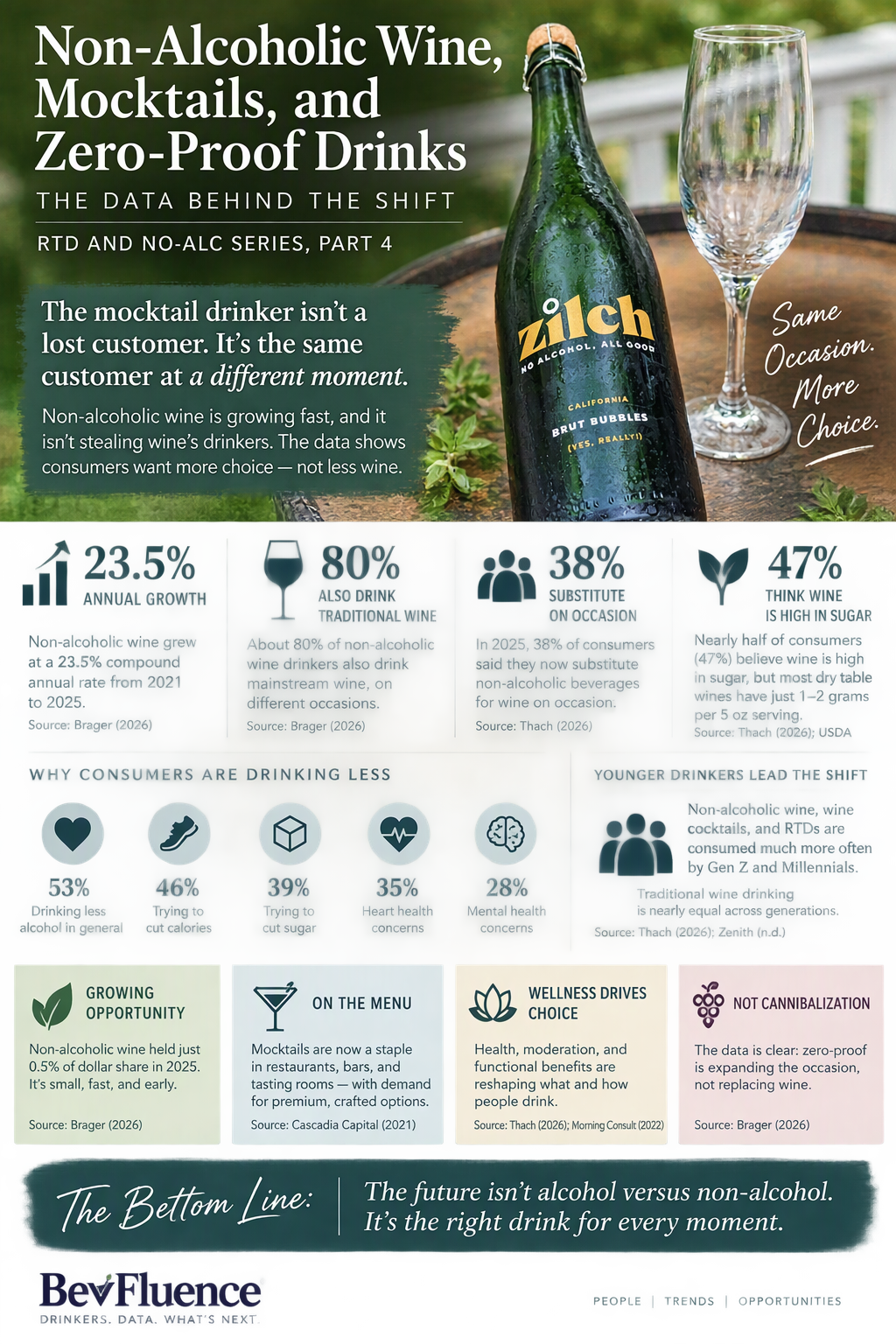
Non-alcoholic wine was the fastest-growing ABV band in U.S. wine from 2021 to 2025, and it isn’t stealing wine’s drinkers. Danny Brager’s January 2026 data shows non-alcoholic wine grew at a 23.5% compound annual rate over that span. About 80% of non-alcoholic wine drinkers also drink mainstream wine, on different occasions.
That second number is the one that matters. The mocktail drinker isn’t a lost customer. It’s the same customer at a different moment.
This final part of the series follows the money, the drinkers, and the menus. It also covers the regulatory wildcard of cannabis drinks. Every number below has a named source.
The Growth Sits at the Fringes
Brager’s slide is titled “Best ABV Growth At The Fringes.” It tracks compound annual change by alcohol band in total U.S. measured off-premise channels, comparing 2025 with 2021. Non-alcoholic wine led at 23.5%.
The other fringe grew too. Wine at 15% ABV and above grew 8.5% a year. Most bands in the middle declined, and wine under 7% ABV fell 10.9% a year.
Scale still matters. Non-alcoholic wine held just 0.5% of dollar share in 2025, per Brager. It’s small, fast, and early.
Brager’s Read on “No”
Brager’s 2026 opportunity list calls non-alcoholic wine “small, but continued double digit growth with much more upside.” He lists it under “better for you,” next to reduced-sugar wine. His advice on reduced sugar is to “make it prominently known.”
His “Better for You” slide tracks selected segments from 2021 to 2025. Non-alcoholic, lower-calorie, and reduced-sugar wines all appear there. The slide’s title says the segments are increasing.
Thach’s opening recommendation for 2026 lines up. Under “Lean Into Wellness Trend,” she tells wineries to add a no- or low-alcohol wine. She also suggests ingredient or nutrition labels and a “no sugar added” claim, if it’s true.
The Pressure Behind the Shift
Brager opened his 2026 presentation with a hard frame. Wine and all beverage alcohol categories are in decline, all at one time. He lists the pressures plainly.
- The economic and geopolitical backdrop is challenging.
- Consumer lifestyles and demographics are changing, which shifts drinking habits.
- Anti-alcohol voices are “fanning the flames.”
- Drinking choices, inside and outside beverage alcohol, are expanding fast.
- The commercial environment is being squeezed.
Thach’s segmentation shows the result in wine. About 29% of American adults drank wine in 2025, down from 34% in 2023. Over the same span, abstainers who don’t drink alcohol at all rose from 26% to 29% of adults.
The Core Is Shrinking
Thach’s data splits wine drinkers by frequency. Core drinkers, who drink wine at least weekly, fell from 20% of adults in 2023 to 16% in 2025. Marginal drinkers fell from 14% to 13%.
Those two groups add up to the headline drop, from 34% to 29%. The loss came mostly from the most frequent drinkers. That’s not a trend wine can wait out.
Non-adopters held at 29% in both years. These adults drink beer and spirits but little or no wine. They’re the audience a non-alcoholic or low-alcohol wine can also reach.
Who’s Choosing Non-Alcoholic
Thach’s Wine Market Council data shows the shift among wine drinkers. In 2025, 38% of consumers said they now substitute non-alcoholic beverages for wine on occasion. Wine drinkers reported drinking more non-alcoholic wine, beer, and spirits in 2025 than in 2023.
The age split is clear. Thach reports non-alcoholic wine, wine cocktails, and RTDs are consumed much more often by Gen Z and Millennials. Traditional wine drinking is nearly equal across generations.
Brager’s cross-over stat explains the pattern. About 80% of non-alcoholic wine drinkers also drink mainstream wine. They choose based on the occasion, not on a lifelong decision.
Why People Are Cutting Back
Thach asked people why they’re drinking less wine. The top answer, at 53%, was drinking less alcohol in general. Fewer wine occasions followed at 25%.
Diet and health drove much of the rest. Among those who said alcohol didn’t fit their diet or health, 46% were trying to cut calories. Another 39% were trying to cut sugar, and 36% said alcohol provides no nutrition.
Further down the list, 35% cited heart health and 28% cited mental health. Reducing carbs drew 27%, cancer risk drew 21%, and avoiding additives drew 17%. And 11% said they were currently taking a GLP-1 medication.
Non-drinkers of wine gave a physical reason too. Thach reports 10% of them said wine makes them feel physically bad. For that group, a non-alcoholic option keeps the ritual without the effect that keeps them away.
The Sugar Misconception
Thach’s data shows 47% of consumers believe wine is high in sugar. Her slide quotes the USDA: the average dry table wine has one to two grams of sugar in a standard five-ounce serving. That gap between belief and fact is a labeling problem.
Thach also asked where people think wine’s sugar comes from. Most named natural grape sugars. But many also believed producers add sugar or sugar substitutes during production.
That’s why Thach’s “no sugar added” advice carries a condition. The claim has to be true. A false wellness claim isn’t a shortcut.
The Moderation Mindset Is Global
Zenith’s alcohol business intelligence report frames moderation as a long-term shift. It cites the Bacardi Global Brand Ambassador Survey 2020: 22% of consumers globally are drinking less. And 55% of mindful drinkers are choosing low-ABV drinks.
Zenith’s own survey covered shoppers in the U.K., France, Germany, and Italy in November 2020. It found 31% had changed what they consumed in the past year. Of those, 57% did it to be healthier.
Zenith compares drinking to diet. Consumers cut meat and adopted flexitarian diets. They’re taking a similar flexible, mindful approach to alcohol.
Younger Drinkers Lead It
Zenith, citing Global Web Index, reports 63% of 18- to 34-year-olds in Europe, North America, and Asia call themselves non-drinkers or occasional drinkers. Moderation resonates more strongly with younger consumers. Zenith ties hard seltzer’s success to the same mindful instinct.
Grand View Research flags the trend as a restraint on RTD cocktails. Non-alcoholic RTD consumption is rising in France, the U.K., Germany, Spain, and Canada. Consumers are leaning toward functional drinks that promise immunity support or stress relief.
FlavorSum’s 2021 e-book points to the product response. Low-alcohol RTD launches emerged at 2% to 3.7% ABV. FlavorSum ties them to drinkers who want more control and to the sober curious movement.
Low ABV Was Already Winning Online
Linkfluence’s 2020 study found low ABV was the topic of highest engagement among RTD alcohol-content conversations. Many drinkers liked lighter drinks to avoid heavier alcohol and hangovers. Others liked the flexibility to mix them or drink them alone.
Linkfluence also found low calorie, carb, and sugar talk drew the highest engagement of any functional driver. Low calorie content drew 57% of conversation about RTD intake. Drinkers wanted to stay healthy without giving up drinking entirely.
Influencers drove that engagement, per Linkfluence. Consumers rarely posted about low-carb or low-sugar drinks themselves. But they engaged heavily when influencers did, which shows quiet interest at scale.
That’s the bridge from RTDs to zero-proof. The same drinker who chose a 5% seltzer over a cocktail now has a zero-proof option too. The occasion stays, and the alcohol becomes a choice.
The Money Followed
Cascadia Capital’s Fall 2021 market update counted beverage deals over the four quarters ending October 2021. Non-alcoholic beverages led every category with 23 transactions. Wine had 16, spirits 15, and beer five.
Cascadia ties that to younger drinkers consuming less alcohol. Health and wellness trends kept driving growth after the pandemic. Drinkers moved from juices and sodas toward functional drinks with added benefits.
The deal list shows where the bets landed. Cascadia’s tables and narrative include these 2021 non-alcoholic transactions:
- Alliance Consumer Growth invested $50 million in Athletic Brewing in May 2021.
- Morgan Creek Capital closed a deal for Lyre’s in May 2021.
- CAVU Ventures funded Poppi, a sparkling drink with apple cider vinegar and fruit, with $13.5 million in August 2021.
- First Beverage Group and Manna Tree acquired Health-Ade, a kombucha brand Cascadia says tops $200 million in annual retail sales.
- Nestlé Health Science acquired Nuun, a maker of low-sugar effervescent tablets and powders.
Functional Drinks Set the Pace
Cascadia cites SPINS data showing the functional soda category grew about 465% year over year through June 13, 2021. It credits drinkers who missed classic soda but wanted less sugar. Less sugar was the selling point.
Cascadia also cites Fast Company on the natural beverage segment. The $13 billion U.S. natural beverage segment is growing at twice the pace of conventional brands. Zevia, Oatly, and Vita Coco all went public in 2021.
The Better-for-You Cooler
Cascadia’s wider deal list shows how crowded the better-for-you cooler got. Coca-Cola closed a deal for BodyArmor in February 2021. Nestlé closed a deal for Essentia in March 2021, and Durable Capital Partners put $106 million into Super Coffee in August.
Mushroom-based drinks drew money too. Silas Capital invested $21 million in MUD\WTR in May 2021. Cascadia describes its blend of chaga, reishi, lion’s mane, and cordyceps mushrooms as “believed to exhibit health benefits.”
Cascadia also charts the global functional beverages market, citing Fior Markets. It runs from $125 billion in 2020 to a projected $217 billion in 2028. Zero-proof wine is a small boat in a big harbor.
That’s the competitive set for any zero-proof wine or spirit. It isn’t only other non-alcoholic wines. It’s every functional, low-sugar, better-for-you drink in the cooler.
Eco Signals Read as Wellness
Thach’s Wine & Wellness study asked whether certain wines are healthier than conventional ones. Certified organic grapes drew 45% agreement. Natural wine and certified organic wine each drew 42%, and certified sustainable drew 26%.
Thach notes positive respondents skew much younger. Younger drinkers link environmental care with personal health. That shapes how they read any “better for you” label.
Zenith makes a similar point about brands. Consumers expect brands to be transparent about what’s in their products and how they’re made and packaged. Authentic communication about those choices now shapes purchase decisions.
Zero-Proof Is Harder to Make
Removing alcohol removes a preservative. FlavorSum notes lower-ABV drinks need additional preservatives to hold shelf life and quality. Sodium benzoate is standard unless the process includes tunnel pasteurizing.
Natural acids like citric acid pair well with vinegar or shrub-style drinks. But FlavorSum says preservatives remain essential at low ABV unless the drink is bottle-fermented. A zero-proof launch needs a stability plan from day one.
Regulators watch this space too. FlavorSum notes alcohol-free malt beverages can require laboratory analysis and samples as part of a formula application. Non-alcoholic doesn’t mean unregulated.
Grand View’s Health Signal
Grand View Research ties the move away from alcohol to health worries. It cites rising rates of obesity and liver disease. Consumers are cutting alcohol and moving toward healthier drinks and fortified water.
It also notes the growing popularity of probiotic drinks. Consumers want functional benefits from what they drink. That raises the bar for zero-proof products that offer only the absence of alcohol.
A zero-proof wine has to give a reason to choose it, not just a reason to avoid something else. Flavor, occasion, and story do that work. “No alcohol” alone doesn’t.
Mocktails Moved Onto the Menu
Cascadia reports non-alcoholic drinks entered on-premise through a premium approach. Restaurant diners increasingly asked for health-focused craft mocktails. They wanted the uniqueness and flair cocktails provide.
Cascadia names one example. Enroot Sparkling Cold Brew Tea was crafted with chefs from the James Beard Foundation and backed by Brad Pitt. It was built to pair with fine-dining menus.
Brager’s 2026 data shows why that matters for wine. At casual restaurants, even wine drinkers almost equally prefer spirits or no alcohol. The mocktail isn’t fighting for a niche seat anymore.
Brager also finds wine-and-food occasions increasingly compartmentalized. Wine is being pushed into special occasions and formal venues. Casual dining is where the zero-proof drink and the cocktail are winning.
The Everyday Occasions Wine Is Losing
Thach’s 2025 occasion data shows where everyday wine drinking sits. Relaxing at home after work drew 42%. Weekday dinner at home, casual restaurant dinners, and socializing at home each drew 39%.
Those are the moments where a zero-proof option fits easily. A weeknight dinner or a casual meal out is exactly where moderation shows up. Wine is weakest in these moments, and choice is strongest.
Special occasions still belong to wine, per Thach. Romance, gifts, and formal dinners top the list. The everyday table is the one up for grabs.
Inclusivity Without Pressure
Mocktails let everyone take part in a social moment without pressure to drink. That includes designated drivers, people on a wellness plan, and anyone pacing their night. A good zero-proof option keeps them at the table.
Thach’s data shows how wide that group is. Nearly four in 10 consumers substitute non-alcoholic drinks for wine on occasion. That’s not a fringe group to accommodate.
Brager’s on-premise advice fits here. He tells wineries to reframe on-premise around pricing, cocktails, and food pairings. A zero-proof drink with real thought behind it fits all three.
Sophistication Without Sugar
The old mocktail was a sugary stand-in. Today’s version competes on complex flavors, premium ingredients, and presentation. Drinkers expect the same care they’d get in a cocktail.
Thach’s young-adult research shows what pulls younger drinkers in. One respondent said they’re “drawn to the signature cocktails and their fun descriptions” on a menu. A zero-proof signature drink can use that same pull.
Thach’s top diet concerns tell the menu what to avoid. Calories and sugar led the list. A mocktail loaded with syrup misses the reason many guests ordered it.
How Drinkers Feel About Choosing It
Drinkers who choose zero-proof describe a few clear feelings. They feel empowered to put their own well-being first. They feel free from pressure to drink and from the next-morning cost.
They also want an elevated experience. Attention to detail in a modern mocktail signals care, the same way a good cocktail does. A plain soda with a lime wedge doesn’t deliver that.
Linkfluence’s 2020 data showed the same feelings driving RTD choices. Drinkers posted about avoiding hangovers and choosing the “smart” option. Zero-proof extends that logic all the way down.
Where Mocktails Are Showing Up
Mocktails now fit a wide range of public settings. Here’s where the original notes for this piece placed them, with data where we have it:
- Social gatherings: from parties to dinners at home. Drizly found 69% of 2020 respondents drank during virtual happy hours, a sign of how flexible social drinking had become.
- Restaurants and bars: Cascadia documents premium mocktail demand on-premise, and Brager shows casual diners split among wine, spirits, and no alcohol.
- Work events: corporate functions and networking events need a non-alcoholic option that doesn’t feel like a consolation prize.
- Wellness retreats and fitness classes: settings where a refreshing zero-proof drink fits the purpose of the event.
Tasting Rooms Are Next
Brager’s fourth 2026 recommendation is to treat tasting rooms as hospitality centers. He calls for choices beyond wine. A zero-proof option belongs on that list.
Thach makes a parallel suggestion. She recommends adding a wine cocktail to the tasting room, built with flavors like ginger, passionfruit, tarragon, or rooibos. The same creativity works for a zero-proof drink.
Brager’s second rule points the same way: meet consumers when and where they are, and around what they’re doing. A tasting room visit is a group occasion. Not everyone in the group drinks the same way.
The logic is simple. A group visits a winery together. If one guest isn’t drinking, the winery either serves them well or loses the group’s next visit.
Zero-Proof Has Its Own Medals
The American Craft Spirits Association’s 2026 yearbook lists the fifth Craft Spirits Packaging Awards winners. The Zero Proof gold went to Bittersweet Aperitivo from Wilderton Aperitivo Co. in Oregon. Zero-proof now competes in its own category alongside gin, rum, and whiskey.
That’s a craft spirits association treating non-alcoholic products as part of the craft. It isn’t a side table. It’s a medal category.
Cascadia’s deal list shows the investment side of the same story. Lyre’s and Athletic Brewing both appear among its 2021 non-alcohol deals. Athletic Brewing’s round alone was $50 million.
The Cannabis Wildcard
Morning Consult’s Q1 2022 State of Food & Beverage report tracked cannabis-infused food and drink. Awareness of CBD reached 65% of U.S. adults, up just five points since June 2019. But usage climbed from about one in four adults to one in three.
Perceptions of legality shifted too. Morning Consult reports 73% of consumers say CBD is legal, up from 61% in 2019. Millennials showed the highest usage and interest.
Morning Consult found U.S. adults were just as likely to have tried THC-infused food and drinks as CBD-infused ones. Millennials were roughly twice as likely as adults overall to have tried both. Nearly three in 10 Millennials had tried CBD- and THC-infused beverages.
Interest Runs Ahead of Use
Morning Consult reports more than six in 10 Millennials expressed interest in trying food or drinks with CBD and THC. Regular use was still limited. Morning Consult found only a small segment of users consumed these products every day or a few times a week.
Morning Consult places this in a stressed-out moment. In January 2022, 61% of Millennials and 52% of all Americans said “anxious” described their mood well. Ingredients tied to calm and relief gained attention in that climate.
Morning Consult says consumers link CBD most with pain relief. Millennials were especially drawn to mental wellness benefits, like reducing anxiety and improving sleep. Those are consumer beliefs from a survey, not verified health claims, and we report them that way.
Format Preferences
Morning Consult asked which CBD formats people want to try. Gummies and creams or lotions led. Food items and drinks followed, ahead of oils, powders, and pills.
Morning Consult reads that as a desire for a sensory experience. The least involved formats sat at the bottom. A drink is a sensory format, which puts beverages in the conversation.
Morning Consult’s advice to adult beverage brands is pointed. They need to widen their competitive set to include CBD and THC beverages. It also calls THC’s path in food and beverage one with “federal legality pending.”
What Producers Face
FlavorSum notes THC, CBD, and cannabis-infused seltzers are emerging in some North American regions. Each ingredient brings bitter notes the formula has to manage. Part 2 covers the bitterness fixes.
The legal picture is the bigger hurdle. Rules for cannabis ingredients in beverages vary by place. Any brand exploring this lane needs current legal advice before it formulates.
For most beverage brands, the near-term move is simpler. Cannabis drinks compete for the same “something other than alcohol” moment. Knowing that is enough to sharpen a zero-proof strategy.
What Zenith Tells Brands to Do
Zenith’s report closes with a clear brief for alcohol brands. Brands need to balance digital content and virtual experiences with a changed on-premise environment. Knowledgeable consumers expect information and inspiration.
Zenith also says conscious consumerism and mindful consumption will keep shaping purchases. Brands need to be open about ingredients, production, and packaging. And they need to be authentic in how they talk about it.
That brief fits zero-proof perfectly. A non-alcoholic product invites more questions, not fewer. The brand that answers them clearly earns the trial.
The Objection, Named
The real objection to non-alcoholic wine isn’t taste. It’s fear: if we sell zero-proof, we teach our own drinkers to drink less of our core product. Brager’s data answers that directly.
About 80% of non-alcoholic wine drinkers also drink mainstream wine. They switch by occasion, not by identity. The occasion they’d skip otherwise goes to another category or to nothing at all.
Thach’s data closes the loop. Already, 38% of consumers substitute non-alcoholic drinks for wine on occasion. The question isn’t whether that happens, but whose product they pick when it does.
Wine Has a Story to Tell
Thach’s ninth recommendation is to proclaim wine’s positive story. Her list includes agricultural roots, family, connecting friends, relaxation, moderation, food, and 8,000 years of history. Non-alcoholic wine can carry most of that story too.
Brager adds two related moves for 2026. His third recommendation is to partner and collaborate with others, inside and beyond wine. His eighth is to “Promote Wine AND Social Fitness.”
Wine Market Council’s motivation data shows why. Drinkers enjoy wine because it makes occasions feel special, helps them relax, and goes well with food. They also see it as a social or romantic drink and a more moderate one.
A non-alcoholic wine that keeps those feelings keeps the brand in the moment. A brand that refuses to make one hands that moment to a functional soda. That’s a choice, and the data says it’s the wrong one.
What to Do Next
The data from 2020 to 2026 supports a short action list. None of it guarantees results. All of it follows the evidence above.
- Add a no- or low-alcohol option. Thach’s first 2026 recommendation, backed by Brager’s 23.5% growth figure.
- Label honestly. Use ingredient or nutrition labels, and claim “no sugar added” only when it’s true.
- Build a real zero-proof menu item. Complex flavor, low sugar, and real presentation, not a soda with a garnish.
- Train the tasting room. Treat it as a hospitality center with choices beyond wine.
- Watch the competitive set. Functional sodas, kombucha, and cannabis drinks compete for the same moment.
Series Wrap
Part 1 showed RTDs taking share while drinking shrank. Part 2 showed what goes into a can that drinkers come back to. Part 3 showed that age and occasion, not gender, define the RTD drinker.
Part 4 shows the next step in the same trend. Drinkers want choice in flavor, format, strength, and alcohol itself. The brands that offer that choice keep the drinker in every occasion.
The old model sold one product for every moment. The data says that model is done. The next one sells the right drink for each moment.
References
American Craft Spirits Association. (2026). 2026 craft spirits yearbook [Annual yearbook].
Brager, D. (2026, January 28). Consumer demand: At the crossroads [Conference presentation]. Unified General Session, Sacramento, CA, United States.
Cascadia Capital. (2021). Beverage industry market update: Fall 2021 [Market report].
Drizly. (2020). Drizly consumer survey report 2020: Alcohol shopping and attitudes, mid-2020 [Survey report].
FlavorSum. (2021). How to master formulation challenges in the “Wild West” of RTD cocktails: Guidelines for brewers and distillers [E-book].
Grand View Research. (n.d.). Ready to drink cocktails market analysis and segment forecasts to 2028 [Sample report].
Linkfluence. (2020). Hard seltzers, canned wine and canned cocktails: What’s driving the ready-to-drink beverage boom? [Social intelligence report].
Morning Consult. (2022). The state of food & beverage: Q1 2022 [Analyst report].
Thach, L. (2026, January). The pulse of the U.S. wine consumer: Opportunities in 2026 and beyond [Conference presentation]. Wine Market Council, Unified Symposium, Sacramento, CA, United States.
Zenith. (n.d.). Business intelligence – Alcohol: Beer + spirits [Industry report].