BevFluence TERROIR Campaign – “T” is for Touriga and other Portuguese Varieties
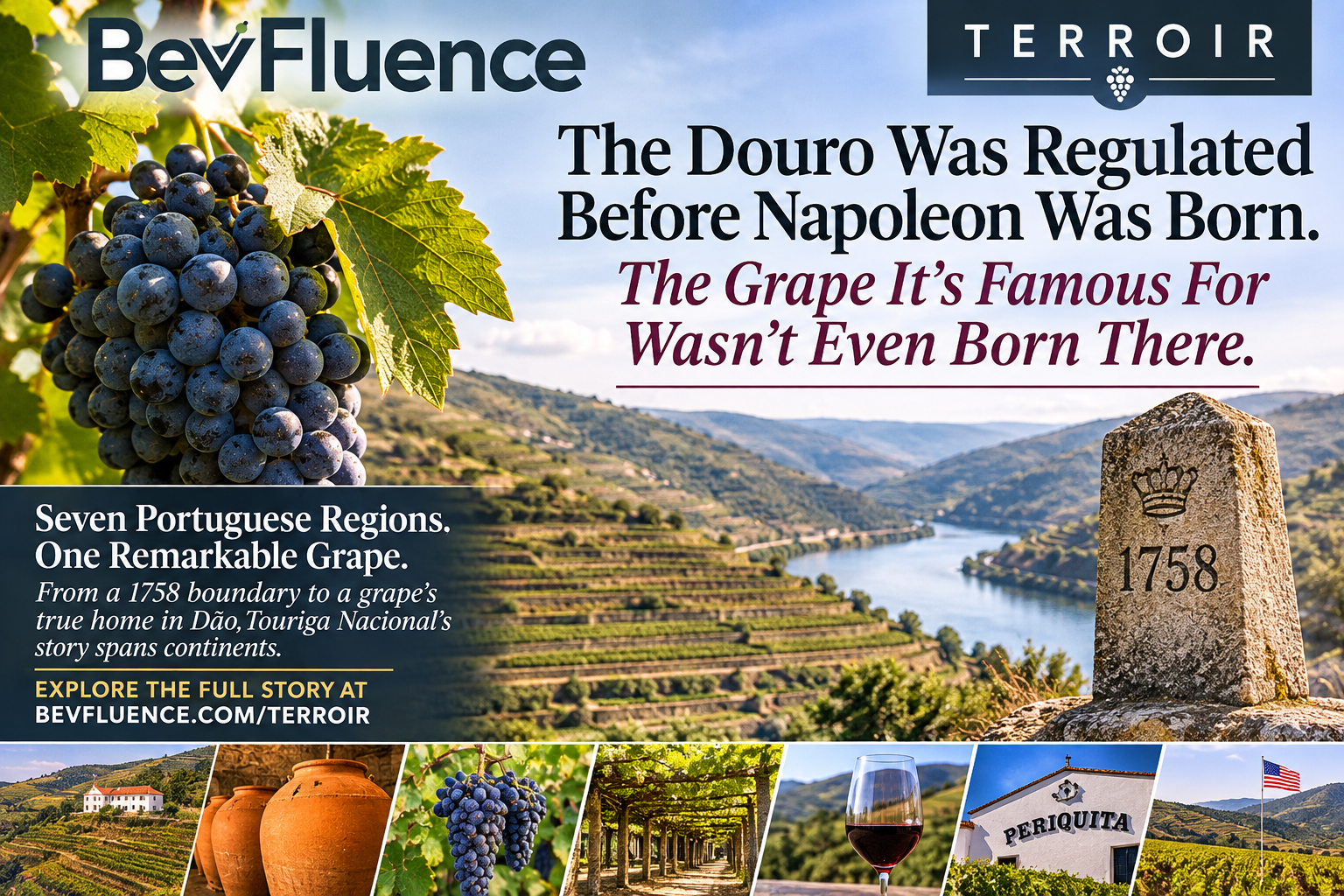
The Douro Valley was formally demarcated between 1758 and 1761 under the Marquis of Pombal, marked out with 335 granite boundary pillars — making it the world’s first formally regulated wine region, a fact that predates Bordeaux’s famous 1855 classification by nearly a century. That regulation was built entirely around one product: fortified Port. Everything else the Douro makes today grew up inside a legal framework designed for something else.
Here’s the part almost nobody gets right: Touriga Nacional, the grape most associated with the Douro and with Port itself, genetically originates in Dão, not the Douro — grown there in coarse granite soil at 200 to 800 meters elevation, where wide diurnal temperature swings preserve acidity the Douro’s own heat can’t match. Most American wine lists credit the wrong region for the grape’s origin, and Caves São João, distilling that Dão identity into bottle-aged Touriga Nacional and Encruzado blends since the 1920s, has been quietly correcting that record for a century.
Meanwhile, a group of Douro producers now called the “Douro Boys” — Niepoort, Quinta do Crasto, Quinta do Vale Meão, Quinta do Vallado, and Quinta do Vale Dona Maria — spent the late 1980s and 1990s proving the region’s schist-terraced vineyards could make dry table wine as serious as Bordeaux or the Rhône, not just Port. Quinta do Crasto still works field blends up to 90 years old in traditional granite lagares. That’s a region built for one wine, repurposed for another, by producers whose names you can still look up.
Alentejo took a completely different production path: Vinho de Talha, ambient-yeast fermentation in buried terracotta amphorae, running alongside a modernist stainless-steel export operation at estates like Herdade do Esporão. Bairrada rebuilt a difficult grape’s reputation entirely through one winemaker’s technique — Luís Pato was the first to systematically de-stem Baga to tame its harsh tannins, treating it as a serious varietal instead of a problem grape. And Minho’s Vinho Verde region used to train its vines onto pergolas specifically to keep them off wet ground in one of Portugal’s rainiest climates — a rot-prevention decision, not an aesthetic one, before modern low-wire trellising largely replaced it.
The same grape at the center of all this — Touriga Nacional — is now planted with real intent across four American states: California, Virginia, Oregon, and beyond. Cass Winery in Paso Robles, St. Amant in Amador County, Chrysalis Vineyards in Virginia, and Abacela in Oregon all picked the grape for a specific climate reason — heat tolerance, rot resistance, acid retention — not as an import novelty. A 265-year-old regulated region and a handful of deliberate American plantings are telling the same story on two continents, just with different soil under it.
Setúbal Peninsula rounds out the seven-region roster with a naming quirk that outgrew the brand it started as: José Maria da Fonseca, founded in 1834, released its Castelão as Periquita, and the name stuck so well that Periquita became the grape’s own nickname across southern Portugal. The same estate is Portugal’s oldest producer of Moscatel de Setúbal, a fortified wine aged for years or decades on Serra da Arrábida’s limestone slopes — two separate legacy claims from one estate that most single-category producers never accumulate in nearly two centuries of continuous operation.
Seven regions, seven completely different production stories — a legal boundary drawn in 1758, a grape’s true genetic home hiding behind a more famous neighbor, amphora fermentation running next to export-grade stainless steel, one winemaker’s technical fix rewriting a whole grape’s reputation, a training system built to fight rain, a brand name that ate its own grape’s identity, and four American states proving the variety wasn’t a Portuguese exclusive to begin with. TERROIR’s Touriga category isn’t asking anyone to discover a single hidden grape. It’s asking them to catch up on seven different arguments that have been happening in plain sight.
This window for registering for the BevFluence Terroir campaign closes October 31, 2027. What’s happening in Campania won’t wait for the next cycle. Be in it — bevfluence.com/terroir