BevFluence TERROIR Campaign – “T” is for Touriga and other Portuguese Varieties
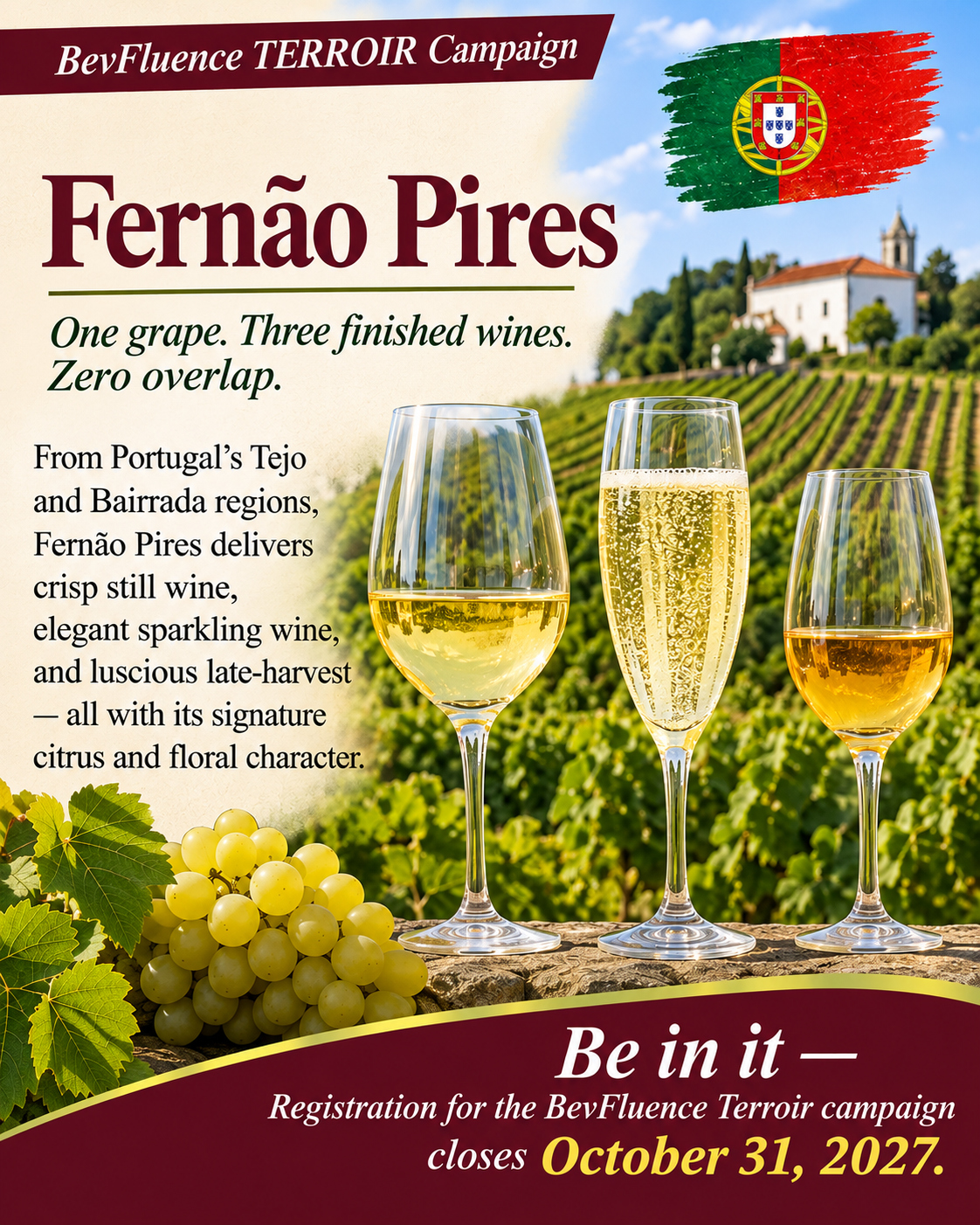
Fernão Pires makes a still wine, a sparkling wine, and a late-harvest wine, and none of the three taste like a compromise for having shared a vineyard. That range is unusual enough that most grapes capable of it get treated as a novelty rather than a serious varietal — Fernão Pires gets the opposite treatment in Portugal, where its versatility is simply understood as the grape’s defining trait.
The grape’s home is Portugal’s Tejo and Bairrada regions, where DFJ Vinhos produces it aromatic, floral, and citrus-driven across all three styles. Tejo’s warmer, flatter terrain and Bairrada’s cooler clay-limestone soil give the grape two distinct starting points before a winemaker even decides which finished style to pursue, which partly explains how one variety supports such different outcomes without any single version feeling like an afterthought.
Wines of Portugal, the country’s trade body, and Brands of Portugal, the US importer and distributor, are the two organizations positioned to move Fernão Pires into American accounts — infrastructure that exists specifically because Portugal’s own wine industry considers the grape worth exporting seriously, not because an outside market discovered it independently. That’s a meaningful distinction: this isn’t an obscure grape an importer stumbled onto, it’s a grape Portugal’s own trade apparatus has decided deserves international representation.
The still version leans into citrus and floral lift with enough acidity to work as a genuine food wine rather than a simple aperitif. The sparkling version takes the same aromatic profile and adds structure through secondary fermentation. The late-harvest version concentrates the grape’s natural sugars into something closer to a dessert wine, without losing the citrus character that defines the other two styles. Three distinct occasions, one grape, and DFJ Vinhos treats all three as equally serious production lines rather than a flagship style with two side projects attached.
That range — still, sparkling, late-harvest, same grape, consistently serious across all three — is the proof the category needs. A grape that can carry three separate finished styles without a flaw in any of them isn’t a curiosity. It’s a versatile variety that happens to have no meaningful US footprint yet, which is a gap in market presence, not a gap in the grape’s actual capability. Part of that market gap traces back to how Portuguese white wine gets marketed abroad in general: Vinho Verde and Alvarinho have absorbed most of the international attention given to Portuguese whites, leaving grapes like Fernão Pires — despite deeper stylistic range — without the same brand recognition.
That’s a marketing sequencing problem, not a quality one, and it’s exactly the kind of gap a category built on documented specificity rather than existing brand recognition is positioned to close. DFJ Vinhos itself operates at a scale that makes consistent three-style production possible in the first place — a smaller estate attempting still, sparkling, and late-harvest Fernão Pires simultaneously would likely have to compromise on at least one style, but DFJ’s production capacity means none of the three gets treated as the lesser priority. That’s worth stating plainly for a category built on avoiding the “hidden gem” cliché: Fernão Pires isn’t a small-batch curiosity somebody happened to bottle three ways. It’s a mainstream Portuguese production line operating at real commercial scale, which makes its absence from American shelves a distribution gap rather than a supply one.
This window for registering for the BevFluence Terroir campaign closes October 31, 2027. What’s happening in Fernão Pires won’t wait for the next cycle. Be in it — bevfluence.com/terroir