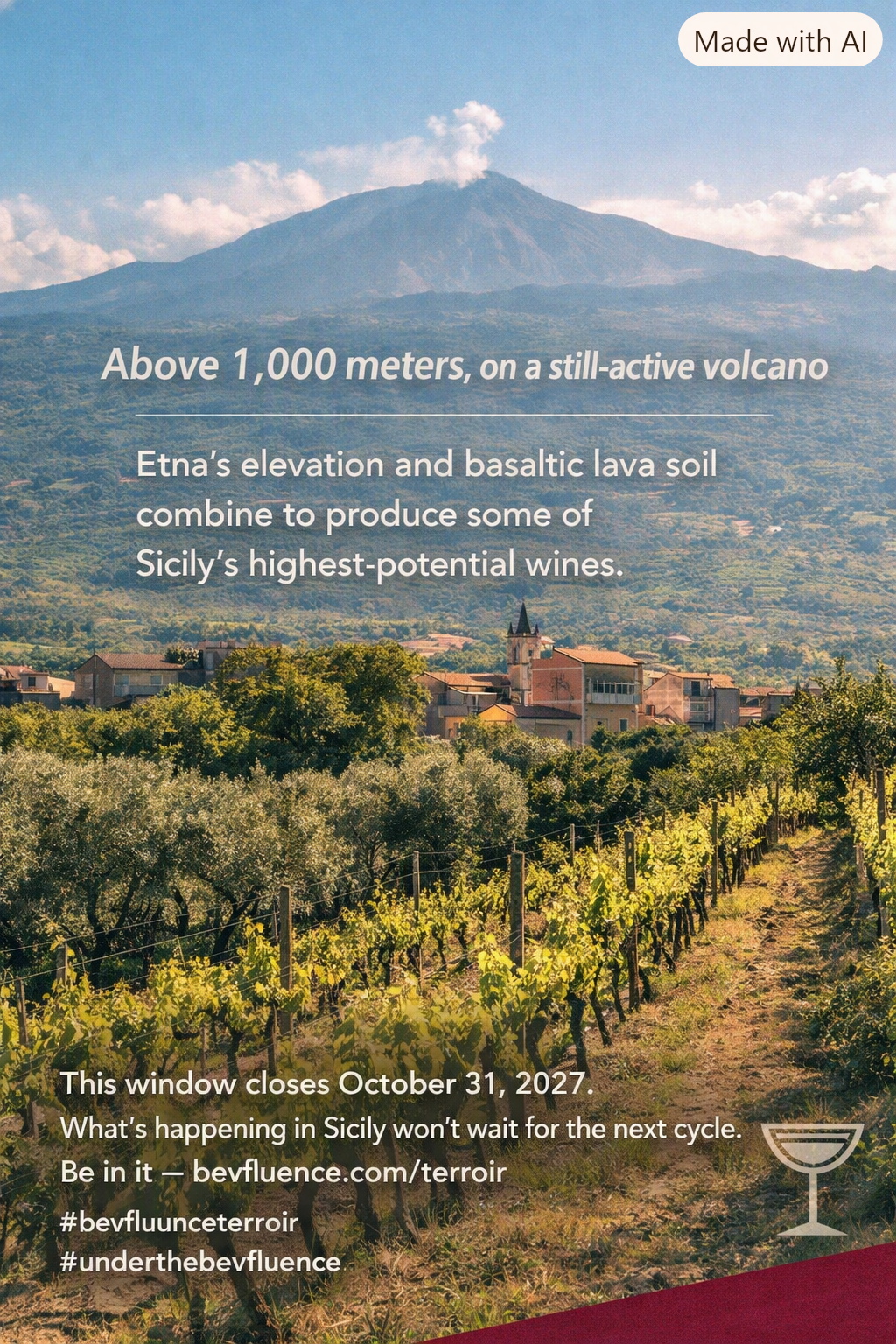
Sicily spent decades known for bulk production and its comeback runs almost entirely through one still-active volcano. On Etna’s northern and eastern slopes, above 1,000 meters elevation, decomposed basaltic lava rock and volcanic ash produce Nerello Mascalese wines pale enough in color and high enough in acid that serious tasters reach for Pinot Noir and Nebbiolo comparisons — not because Nerello Mascalese is derivative of either, but because volcanic soil at that elevation produces the same kind of structural tension those grapes are known for.
Carricante, Etna Bianco’s dominant white variety, grows on the same volcanic ground and yields dry, high-acid whites with white fruit, lime, and a wet-stone salinity that reads like a direct transcript of the soil underneath it. Both grapes depend entirely on Etna’s elevation and geology — take either one off the mountain and the wine stops tasting like Etna.
Grillo, grown primarily in the island’s warmer western and southern zones, fills out the white‑wine picture beyond Etna entirely. Where Carricante is all altitude‑driven acidity and volcanic precision, Grillo leans into Sicily’s maritime heat: fuller‑bodied, saline, often showing ripe citrus and subtle herbal notes that come from coastal breezes rather than mountain air. It’s the clearest reminder that Sicily’s whites aren’t defined solely by Etna’s elevation — they’re shaped just as much by the island’s lower‑lying coastal climates, where ripeness and salinity replace volcanic tension as the dominant signature.
The island’s other signature region works from the opposite climate entirely. In the warmer south, around Noto and Avola, Nero d’Avola thrives in calcareous clay, producing plush red fruit, plum, and sweet spice — riper and rounder than anything Etna’s cooler volcanic slopes could produce. In Vittoria, producers blend that same Nero d’Avola with Frappato, a grape that contributes bright floral aromatics and fresh red berry character, to make Cerasuolo di Vittoria DOCG — Sicily’s only DOCG-level appellation, and the only wine on the island built from a mandatory two-grape blend rather than a single variety.
That’s the actual argument for Sicily as a category: one island, two climates, two soil chemistries, and the region’s highest legal classification reserved specifically for the wine that blends grapes from opposite ends of that range rather than the wine that isolates just one. Etna’s Nerello Mascalese and Carricante prove volcanic elevation can produce Old World tension in what used to be a bulk-wine island. Cerasuolo di Vittoria proves the island’s real signature isn’t a single grape at all — it’s knowing which two to put together.
No US-based Nerello Mascalese, Carricante, or Nero d’Avola producer appears in any project file. That’s a genuine gap for Sicily specifically — flagged, not filled with an invented name.
A category built on a volcano that’s still active, and a DOCG that only exists because two grapes from opposite coastlines happened to work better together than did alone, isn’t a hidden-gem pitch. It’s geology and blending law doing exactly what they’re supposed to do.
The shift itself is worth naming plainly: Sicily spent the back half of the twentieth century known almost entirely for high-yield bulk production shipped north to blend into other regions’ wine. The move toward Etna’s site-driven, high-altitude bottlings and Vittoria’s DOCG-level blending law represents a full reversal of that reputation, built by producers willing to farm at elevations and yields that make no sense under a bulk-production model. Nerello Mascalese’s thin skins and naturally high acidity would have been a liability in the old commodity framework; on Etna’s cooler volcanic slopes, farmed for structure instead of volume, that same thin skin and acidity become the entire point. Elevation is doing more of that work than “volcanic soil” alone would suggest — above 1,000 meters, nighttime temperatures drop enough to preserve the acid that gives Nerello Mascalese its Nebbiolo-adjacent tension, while lower on the same mountain the grape ripens riper and softer. Etna isn’t one terroir. It’s a gradient, and producers choose their elevation the way Burgundy producers choose slope position.
This window closes October 31, 2027. What’s happening in Sicily won’t wait for the next cycle. Be in it — bevfluence.com/terroir. #bevfluenceterroir #underthebevfluence