BevFluence TERROIR Campaign – “R” is for Rhum: Martinique (AOC)
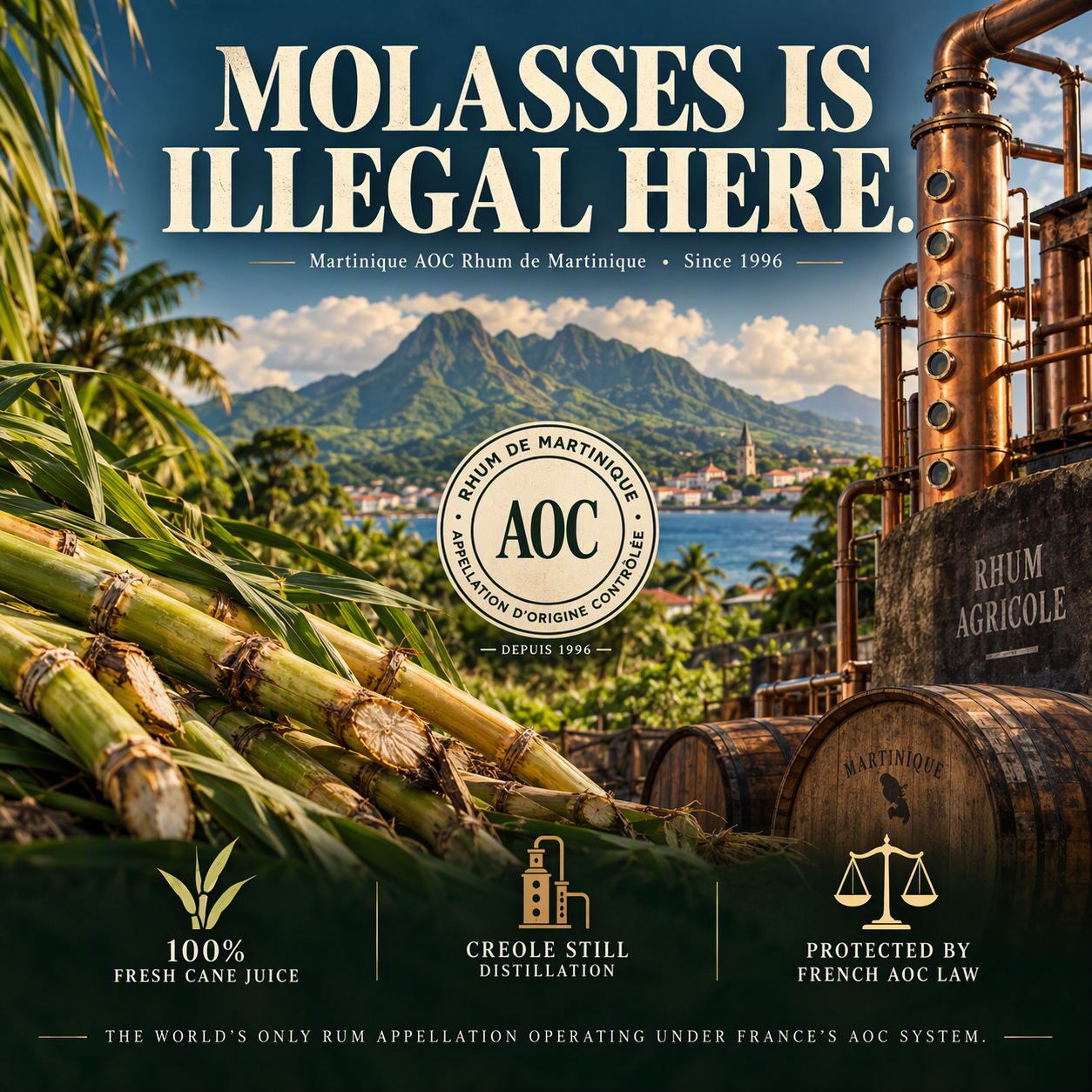
Established in 1996, Martinique’s AOC Rhum de Martinique is the world’s only rum appellation built directly on France’s strict AOC model. The rules prohibit molasses entirely, requiring 100% fresh sugarcane juice, or vesou, to be distilled the same day the cane is harvested. That same-day requirement isn’t a stylistic preference; sugarcane juice begins oxidizing and losing quality within hours of cutting, which means the entire production chain, from field to still, has to move on a tighter schedule than almost any other spirit category demands.
Distillation is restricted by law to single-column Creole stills made entirely of copper, operating with 15 to 25 plates and producing spirit between 65% and 75% ABV — a proof ceiling set specifically to preserve non-alcohol congeners that higher-proof distillation would strip out. That’s a direct legal trade-off between purity and character: the AOC’s rule-makers decided flavor retention mattered more than maximum efficiency, and wrote that priority directly into enforceable law rather than leaving it to individual producer discretion.
Rhum Vieux, the aged category, requires a minimum of three years of tropical maturation in oak barrels holding less than 650 liters, typically 200-liter ex-bourbon or Cognac casks — small enough to accelerate the wood interaction that tropical heat and humidity already speed up considerably compared to temperate-climate aging. Maison Clément, Rhum J.M., Neisson, and HSE all work under these fixed rules, which means comparing producers within Martinique’s AOC is a comparison of terroir and technique within a single, tightly bounded legal framework, closer to comparing Burgundy producers than comparing rum brands generally.
That legal structure is precisely what separates agricole rhum from molasses-based rum on a fundamental production level, not just a stylistic one. A producer operating under the Martinique AOC cannot simply turn to cheaper molasses during a poor cane harvest, as a less-regulated rum producer might. The framework removes that flexibility entirely, forcing producers to solve supply challenges within the fresh-cane-juice requirement rather than around it.
A legal structure this specific, modeled on Cognac’s own rules and enforced with the same rigor, is a stronger claim than “French Caribbean rum” as a loose geographic descriptor. It remains the only rum appellation operating under France’s AOC system, meaning every bottle carrying the designation has already met a legal standard most rum producers worldwide are never required to meet. Rhum agricole’s growing reputation among serious American bartenders over the past decade has run almost entirely on word of mouth from people who understood this legal distinction, well ahead of any coordinated import marketing push explaining it to a wider audience.
This window for registering for the BevFluence Terroir campaign closes October 31, 2027. What’s happening in Martinique (AOC) won’t wait for the next cycle. Be in it — bevfluence.com/terroir.