This Gin Is Foraged from a Floral Kingdom the Size of a Small Country and Nowhere Else
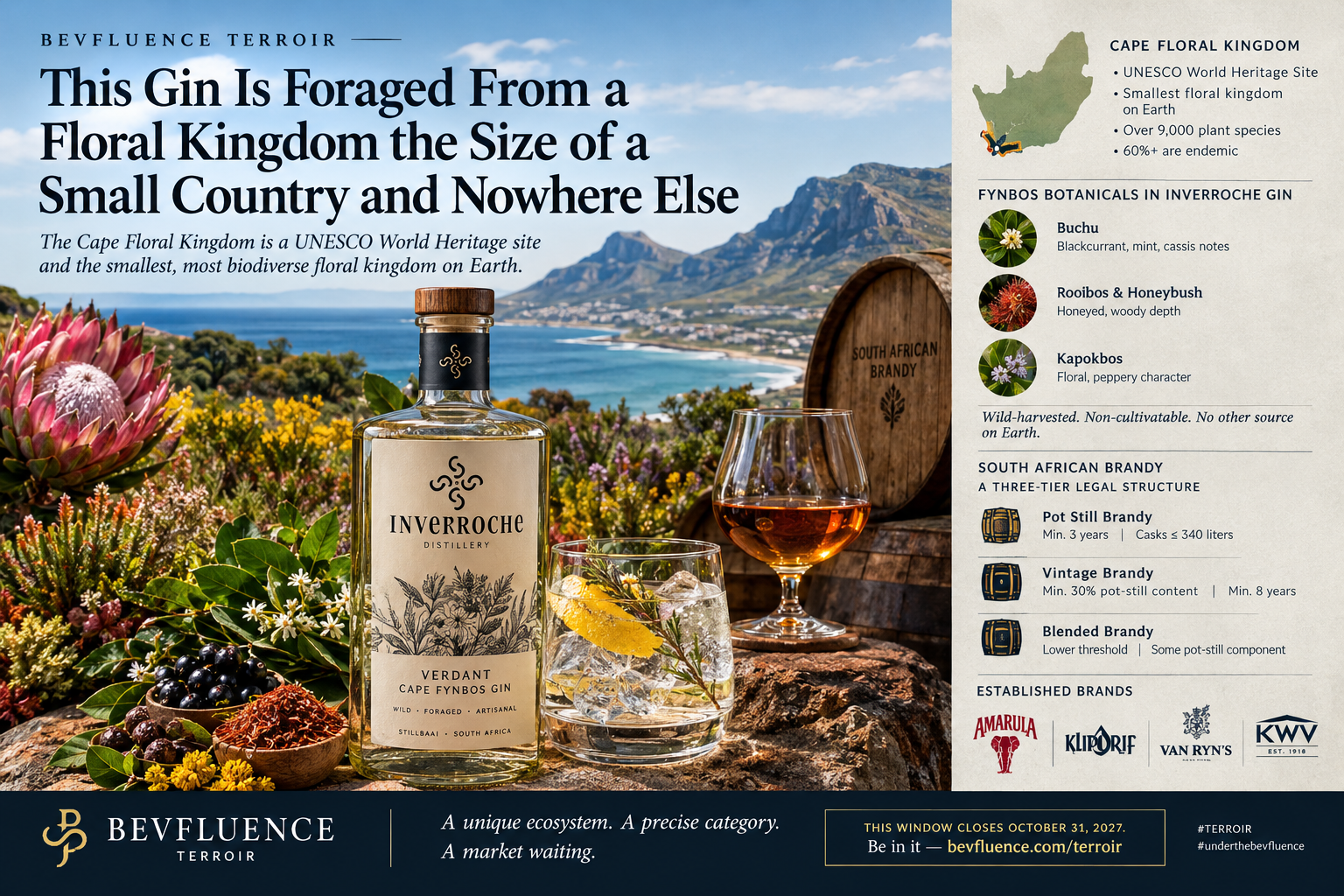
The Cape Floral Kingdom is a UNESCO World Heritage site and the smallest, most biodiverse floral kingdom on Earth — over 60% of its more than 9,000 plant species, collectively called Fynbos, are endemic and grow nowhere else on the planet. That endemism isn’t a minor botanical footnote; it means any spirit built on Fynbos botanicals is working with plant material that has no equivalent sourcing option anywhere else in the world, a supply-chain reality most gin categories built on globally available botanicals like juniper and citrus peel simply don’t share.
Inverroche, based in Stillbaai, forages Fynbos botanicals directly into gins like Inverroche Amber and Verdant. Buchu contributes blackcurrant, mint, and cassis notes. Rooibos and Honeybush add honeyed, woody depth. Kapokbos brings floral, peppery character. Each botanical is wild-harvested from a specific, non-cultivatable regional ecosystem rather than grown to order the way most commercial gin botanicals are, which means Inverroche’s sourcing is constrained by what the Cape Floral Kingdom actually produces in a given season rather than what a farm can be scheduled to deliver.
South African brandy operates under its own three-tier legal structure that most American drinkers have never encountered. Pot Still Brandy requires a minimum of three years aging in casks no larger than 340 liters — a cask-size ceiling that forces more wood contact per liter of spirit than larger barrels would allow. Vintage Brandy requires at least 30% pot-still content aged a minimum of eight years. Blended Brandy operates at a lower threshold, allowing broader commercial production while still requiring some pot-still component. That’s a graduated quality system with real teeth, not a marketing tier structure.
Amarula Cream, Distell’s Klipdrif, Van Ryn’s, and KWV represent South Africa’s broader spirits production infrastructure beyond the Fynbos-gin niche — established brands with real domestic market presence that most Americans have simply never encountered, since South African spirits exports have historically prioritized other markets over the US.
A gin category built on plants that exist nowhere else on the planet, standing next to a brandy classification system as legally specific as Cognac’s own tiered structure, is a considerably more precise pitch than “South African spirits” — a phrase that treats an entire country’s spirits industry as a single undifferentiated geography rather than the botanically unique and legally structured category it actually represents. Amarula Cream, Klipdrif, Van Ryn’s, and KWV prove that infrastructure and market maturity aren’t the missing pieces — South Africa’s spirits industry is fully established domestically. What’s missing is simply the American import and education pipeline connecting that established industry to a market that’s never had reason to look for it. The three-tier brandy system in particular offers American drinkers a genuinely useful comparison point once it’s explained: it’s a legal quality ladder with the same basic logic as Cognac’s VS/VSOP/XO system, just built around cask size and pot-still percentage instead of years alone — a detail most South African brandy exporters have historically assumed, incorrectly, that American buyers would find too technical to care about. Fynbos itself faces genuine conservation pressure from land development and climate shifts, which means Inverroche’s wild-harvest sourcing model isn’t just a flavor choice — it’s directly tied to the long-term survival of the specific plant communities the gin depends on, a sustainability stake most gin categories built on cultivated botanicals never have to reckon with.
This window closes October 31, 2027. What’s happening in African Spirits won’t wait for the next cycle. Be in it — bevfluence.com/terroir