RTD and No-Alc Series, Part 3
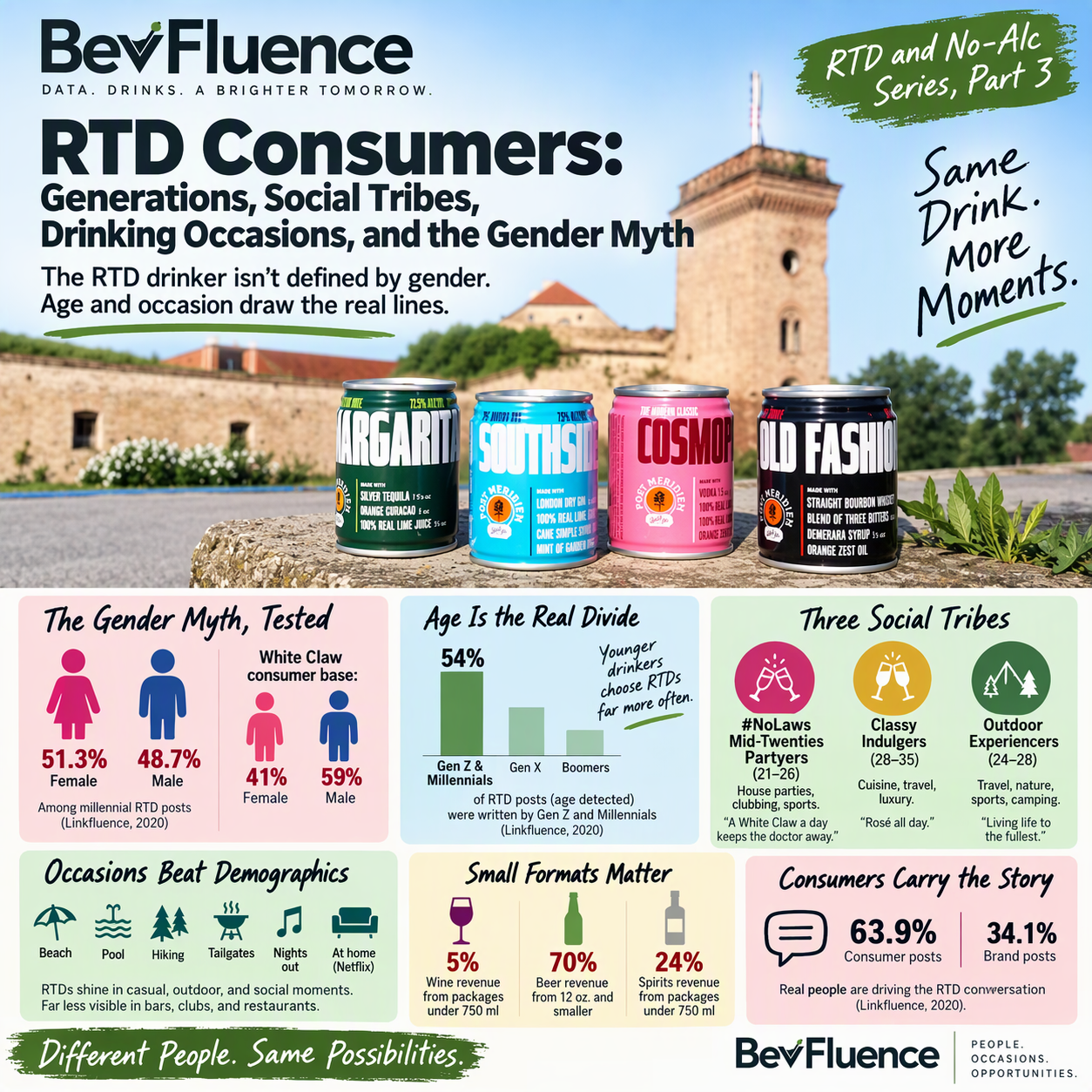
The RTD drinker isn’t defined by gender. Age and occasion draw the real lines. Linkfluence’s 2020 social study found millennial posts about RTDs split 51.3% female and 48.7% male. White Claw’s own consumer base in that data skewed 59% male.
That kills a claim our earlier coverage made. It said women drink more RTDs because the cans are smaller and more “feminine.” The data doesn’t support it, so we’ve cut it.
What the data does show is sharper. Gen Z and Millennials drink RTDs far more often than older adults. They drink them at specific moments, in specific places, for specific reasons.
The Gender Myth, Tested
Linkfluence analyzed 97,000 posts where it could detect the author’s age. Among millennial posts, women wrote 51.3% and men wrote 48.7%. That’s close to even.
White Claw’s split went the other way. Linkfluence reports 41% of White Claw consumers in its data were female and 59% male. The best-selling hard seltzer of 2019 wasn’t a “women’s drink.”
Linkfluence credits the brand’s gender-neutral branding for that. Both men and women shared their White Claw moments, memes, and love for the product online. The report calls White Claw a drink “for anyone and everyone.”
Where the Prejudice Still Shows
The stereotype didn’t vanish. Linkfluence found a small share of male drinkers still called White Claw a drink for women only. Others poked fun at themselves for enjoying a “feminine” drink.
Sports marketing exposed the same tension. Bon & Viv partnered with the NFL to reach fans and stretch beyond summer. But its Super Bowl ad with mermaids landed badly, and many viewers didn’t understand the concept.
Linkfluence’s warning is direct. Despite a gender-diverse target, brands need to be careful with campaign messages aimed at sports fans. A wink at gender can read as a stereotype.
The sports push kept coming anyway. Posts captured by Linkfluence noted the NHL named Truly its official league hard seltzer. Seltzer was moving onto beer’s home turf, and gender-coded messaging was a liability there.
Survey Data Agrees
Drizly’s June 2020 survey of more than 15,000 legal-drinking-age adults tells a similar story. Women edged out men among those who drank hard seltzer the previous summer. Women also slightly edged out men among new home mixologists.
“Edged out” is the key phrase. These are narrow gaps, not a gender-defined category. Any brand building an RTD around one gender is building around a myth.
Wine’s own data shows a similar near-split. Thach’s 2025 Wine Market Council data shows U.S. wine drinkers at 54% female and 46% male. Category lines are softer than old marketing assumed.
Age Is the Real Divide
Linkfluence found the generation born between 1980 and 2000 wrote 54% of RTD posts where age was detected. Citing The Straits Times, it credits Millennials and Gen Z with a big role in the RTD story. Hard seltzers fit that generation’s expectations and the macro trends it drives.
Thach’s 2026 data confirms the gap holds today. All generations report drinking traditional wine at nearly equal rates. But wine cocktails, RTDs of any base, and non-alcoholic wine are consumed much more often by Gen Z and Millennials.
That’s an important split. Younger drinkers didn’t swap wine for RTDs. In Thach’s words, newer generations “DO LIKE WINE. They just drink it less and like a lot of other drinks.”
Gen Z Wants Variety and Education
Drizly defined Gen Z as ages 21 to 26 in its 2020 survey. More than half of Gen Z respondents, 52%, had tried at least one new alcohol brand since mid-March 2020. That outpaced Millennials, Gen X, and Boomers.
Gen Z also wanted to learn. Drizly reports Gen Z topped older groups in wanting more information about cocktail craft, at 48%. It also led on white wine at 31% and on emerging spirits like mezcal and soju.
That’s a drinker who reads labels and watches videos. Thach notes about half of Gen Z was 21 or older in 2025. The rest of that generation is still arriving.
Fewer Drinkers, Lighter Drinking
Zenith’s alcohol report adds a global view. Citing Global Web Index data, it reports 63% of 18- to 34-year-olds in Europe, North America, and Asia call themselves non-drinkers or occasional drinkers. Zenith says moderation resonates more strongly with younger consumers.
Zenith also notes who drinks regularly. Global Web Index data shows people over 35, high earners, and urban residents are more likely to be regular drinkers. RTD brands targeting young adults are targeting lighter, less frequent drinkers.
Brager’s January 2026 presentation titles its youth slide “Drinking Behaviors of Younger LDA’s Have Changed – Drinking Less and Differently.” His data compares 21- to 29-year-olds in 2025 against 2019. The headline says what brands need to hear.
Younger and Older Millennials Want Different Things
Linkfluence split Millennials into two groups. Younger Millennials looked for a fun, guilt-free, tasty party drink. Older Millennials valued convenience and more sophisticated gatherings.
Both groups cared about value, but differently. Linkfluence found Millennials often said they’d pay a little more for a better product, especially canned wine. White Claw’s price drew regular criticism on Twitter.
Millennials also cared about what brands stood for. Compared with other drinkers, they valued brand commitments more. LGBTQ+ inclusivity, recycling, and charity donations were the top three commitments they discussed.
Naturality Was a Millennial Priority
Linkfluence reports Millennials looked for “better for them” drinks. Their taste and quality talk centered on real and natural ingredients. Gluten-free and natural flavor claims came up often.
They also looked for more value and naturality than other age groups, per Linkfluence. They were at the front of RTDs’ digital success. They also brought RTDs into their own gatherings.
Thach’s 2026 wellness data shows the same instinct carries forward. Younger respondents were far more likely to see eco-friendly wines as healthier. The values didn’t fade as Millennials aged.
Thach adds that younger consumers are especially concerned with the environment and fair social practices. She also notes many wineries do good sustainability work but don’t tell consumers about it. Linkfluence showed RTD drinkers praising easy-to-recycle cans as early as 2019.
Three Social Tribes
Linkfluence went past age and built three “tribes” from social posts. Tribes group people by shared language, activities, spaces, and values. Here’s who they found.
The #NoLaws Mid-Twenties Partyers
These are drinkers aged 21 to 26, visible near major U.S. universities. Linkfluence describes them as young Millennials always ready to party. Their favorite drink is White Claw in all flavors, plus easy cocktail combinations.
Their style is house parties followed by clubbing. Their interests are sports, web culture, and healthy or fast food. They post the motto “A White Claw a day keeps the doctor away.”
Linkfluence describes a group that switches between healthy routines and guilty pleasures. To them, White Claw is the “least bad” option for a night out. Because they celebrate often, the least bad drink becomes the star of the party.
The Classy Indulgers
These drinkers are 28 to 35, often young professionals and young parents. Linkfluence finds them especially visible in California. Their favorite pairing is canned wine and crackers.
Their motto is “Rosé all day.” Their interests are cuisine, travel, and luxury. They party in unexpected places, indoors or outdoors, with a cloth and a picnic set.
Linkfluence calls them creative and demanding. They redefine what drinkers expect from a ready-to-drink product. For them, taste and convenience go together.
The Outdoor Experiencers
These drinkers are 24 to 28 and especially visible in U.S. national parks. Linkfluence describes them as seeking extreme outdoor experiences and guilt-free refreshment. Their interests are travel, nature, sports, and camping.
Their favorites are canned wine and Black Cherry White Claw. Their party style is a bonfire night while exploring a national park. Their essentials are a backpack and a life jacket.
Their motto is “Living life to the fullest.” Hard seltzer is part of a backpacking lifestyle for them, not just a drink. They bring it to cool off after hours of activity.
Occasions Beat Demographics
Linkfluence’s top tip for brands was to reinterpret occasions. It told brands to build lifestyle-centered occasions instead of demographic ones. Brager’s first 2026 rule says the same thing: “Format follows Occasion.”
The RTD occasions in Linkfluence’s data are specific. They include the beach, the pool, hiking, tailgates, nights out, picnics, and pre-games. Some drinkers start on a bus or train on the way to a party.
Togetherness and fun drove the trend, per Linkfluence. Drinkers rarely posted about fun alone. RTDs became the drink for unplanned gatherings with no preparation.
Where RTDs Didn’t Show Up
Linkfluence found RTDs far less visible in bars, clubs, and restaurants. Some drinkers said they preferred a freshly mixed cocktail on-premise. At a party, a canned drink was good enough.
Festivals were different. Linkfluence reports RTDs showing up at music festivals and food and drink festivals. RTDs were also slowly moving into sports, a space beer has long owned.
Nights in counted too. Linkfluence found canned wine appealed to drinkers enjoying a night in with Netflix or a favorite movie. Low-proof cans brought alcohol into those cultural moments.
The At-Home Occasion Grew
Drizly’s 2020 survey put numbers on the home occasion. Since March 2020, 92% of respondents said they had a drink while watching TV or a movie. And 69% said they drank during a virtual happy hour with friends or family.
Home buying rose across every group. Drizly reports Millennials led in buying more alcohol for home, at 66%. Gen X and older adults were lowest, at 55%.
Drizly also found 70% of respondents planned to keep drinking less away from home for the rest of 2020. That habit shaped what drinkers expect from a canned drink. It has to work on the couch, not just at the pool.
Each Sub-Category Has Its Own Drinker
Linkfluence compared how each RTD type showed up in consumer talk. Hard seltzer talk looked like the overall RTD pattern, since seltzer dominated the volume. Flavors and low calories, carbs, and sugar stood out most.
Canned wine drinkers talked about convenience far more. Cans let them reinvent how they drink wine. They were also demanding about naturality, know-how, and taste, and looked for premium products.
Canned cocktail drinkers wanted reassurance. Linkfluence found know-how was key, because drinkers wanted proof of quality. Cocktails also showed up in refreshment and alcohol-content talk, thanks to their versatility.
Why Canned Wine Clicked
Linkfluence found canned wine opened up casual settings like picnics, barbecues, and the beach. Drinkers liked having no leftover wine after opening a bottle. Smaller servings also helped when cooking.
One drinker summed up the appeal in plain terms. Canned wine “serves the same purpose as canned beer.” Another said a can beats carrying a bottle and opener to a tailgate, party, or campsite.
That’s the canned wine buyer: someone who already likes wine and wants it in more places. Brager’s 2026 data shows how far wine has to go. Packages under 750 ml made up just 5% of wine revenue, against 24% for spirits under 750 ml.
The Small-Format Gap
Brager’s comparison goes further. Beer in 12-ounce and smaller packages made up 70% of beer revenue. Wine is the only one of the three categories still built almost entirely on one large format.
Thach’s shopper data shows demand is moving. Monthly purchase rates rose for every alternative wine package from 2023 to 2025. Single-serve 187 ml bottles and 375 ml half bottles rose the most.
The drinker is asking for smaller formats. The RTD category already answered. Wine is catching up one package at a time.
The Drizly Shopper Snapshot
Drizly’s June 2020 survey also showed where drinkers shopped before the shift. Local independent liquor stores and bodegas led for at-home alcohol buying. Independent liquor stores make up the bulk of Drizly’s retail partners.
Plans changed fast. Drizly reports 81% of respondents named alcohol delivery in their shopping plans for the rest of 2020. Another 15% planned to use grocery delivery.
Gifting grew too. Drizly reports online gifting share in May and June 2020 beat its December averages. It suggests drinkers wanted to send something to people they couldn’t see.
Slow Return to the Bar
Drizly asked when drinkers would return to bars and restaurants. Only 16% planned to go back without hesitation. About 41% wanted proper precautions first, 13% planned to wait for a vaccine, and 31% had no plans to return soon.
City habits varied. Among the five largest cities in the sample, Houston respondents were most likely to keep drinking more at home. Los Angeles respondents were the most eager to go back out.
That slow return kept drinking at home for months. Drizly found nearly a third of respondents planned to drink at home more often than normal through the end of 2020. Habits formed in that window.
Brand Loyalty Stayed Loose
Drizly found hard seltzer drinkers spread their loyalty. White Claw led, but many drinkers bought several brands. Drizly saw vigorous trial of, and loyalty to, multiple brands at once.
Drizly also watched Gen X and older drinkers. Fewer adults across every group planned to definitely drink hard seltzer in 2020 than in 2019. Drizly flagged older drinkers as the group to watch for trial.
That’s a category where no single brand owns the drinker. Drizly expected craft seltzers to shake up the category as more products arrived. The shelf kept getting more crowded.
The Home Habit Outlasted the Pandemic
Morning Consult’s Q1 2022 State of Food & Beverage report tracked what happened next. Dining-out frequency still hadn’t rebounded to 2019 levels by early 2022. Takeout and delivery stayed stable through 2021, even as dine-in visits climbed.
Younger, wealthier consumers drove takeout and delivery. Morning Consult reports Millennials were four times more likely than Baby Boomers to order takeout or delivery a few times a week or more. Millennials formed their adult eating habits alongside to-go options.
Home cooking held its place too. Morning Consult found 51% of U.S. adults cook because they enjoy it, and 53% of Millennials say the same. That’s the same drinker who learned to mix at home in 2020.
What That Means for RTDs
A drinker who orders dinner in still wants a drink with it. A can travels with takeout, fits the fridge, and needs no bar tools. That’s the at-home occasion RTDs were built for.
Grand View points to the same lifestyle driver. It cites busy lifestyles and hectic work schedules as reasons for growing demand for ready-to-drink products. One distributor quoted in its sample credits a growing working population, including more working women.
The common thread is time. RTD drinkers aren’t lazy. They’re busy, and they want a good drink without building one.
How Drinkers Choose
Thach’s 2025 data shows how wine buyers pick a bottle. The top factor is having tried it before and liked it, at 57%. Price and taste follow at 56% each, then grape variety at 38% and brand at 37%.
That list explains part of the RTD advantage. A flavor name on a can tells the drinker what it tastes like before they buy. A varietal name only helps drinkers who already know the grape.
Price matters on both sides. Thach reports $10 to $14.99 is the most common wine purchase price, followed by $15 to $19.99. Linkfluence found Millennials would pay more for quality but criticized prices they saw as too high.
Where Wine Lost the Casual Occasion
Thach’s 2025 data shows wine retreating to special moments. Romance led wine occasions at 75%, followed by gifts at 71% and formal restaurant dinners at 67%. Social occasions out of home, like bars and parties, came last at 30%.
Thach states it plainly: wine is being pushed into special occasions instead of everyday ones. That’s the exact opposite of where RTDs grew. RTDs own the casual, social, and outdoor moments wine is giving up.
Brager sees the same thing on-premise. At casual restaurants, even wine drinkers almost equally prefer spirits or no alcohol. Wine’s casual seat at the table is open.
Why People Drink Less Wine
Thach’s survey asked people why they’re drinking less wine. The top answer, at 53%, was that they’re drinking less alcohol generally. Fewer wine-drinking occasions came next at 25%.
Health and effects followed. Saying alcohol affects them more than it used to drew 19%, and saying wine isn’t part of a healthy lifestyle also drew 19%. Another 16% preferred other alcoholic drinks, and 14% said wine costs too much compared with other alcohol.
Those who don’t drink wine gave different reasons. Thach reports 39% prefer the taste of other alcoholic beverages and 35% dislike wine’s taste. Another 23% said it doesn’t fit their personality, and 19% found wine hard to choose.
The Trade-Off Is Real
Thach reports about 29% of American adults drink wine, or 76 million people. That’s down from 34% two years earlier. Another 29% are “non-adopters” who drink beer and spirits but little or no wine.
Drizly’s 2020 data shows where some of those occasions went. Hard seltzer drinkers rarely planned to cut other drinks. When they did trade, they traded from cider, wine, and hard lemonade.
That’s why the RTD conversation matters to wine. The can isn’t stealing loyal wine drinkers. It’s winning the moments wine stopped showing up for.
How RTD Drinkers Find and Buy Brands
Drizly reports stay-at-home orders spurred both buying and trial. Gen Z and Millennials led brand trial. Drizly suggests online shopping replaced the bar as the main place drinkers discover new products.
The phone became a shopping tool. Thach reports 38% of wine buyers used a phone to buy wine in 2025, up from 29% in 2023. TikTok use rose 5% from 2023 among respondents, while other channels rose 3% to 4%.
Zenith says the shift leveled the field. Altered on-premise experiences and the rise of e-commerce narrowed the gap between big brands and new entrants. At-home drinking pushed drinkers to experiment across types and brands.
Consumers Drive the Conversation
Linkfluence measured who was actually talking about RTDs. Consumers made up 63.9% of RTD posts, and brands made up 34.1%. Real people were carrying the category.
Influencers drove one topic in particular. Linkfluence found most engagement about low-carb and low-sugar content came from influencer posts. Ordinary consumers rarely posted about it but engaged heavily with it.
Brand posting style mattered. White Claw let its fans lead and posted rarely, as Part 1 showed. That’s a strategy built for a consumer-led category.
What Younger Drinkers Say Is Missing
Thach’s Wine Market Council research on younger and multicultural consumers names the barriers. They include vibe among alternatives, occasion relevance, value, taste, shopping experience, health and wellness, and food pairing. Each one is a place RTDs compete well.
One quote from Thach’s research says it in a sentence. “When I look at a beverage menu, I’m drawn to the signature cocktails and their fun descriptions.” The same drinker said wine lists look the same, with brand and varietal names they don’t understand.
Another drinker described the wine aisle as overwhelming and confusing. RTDs answer that problem with flavor names on the can. A drinker knows what “grapefruit and yerba santa” means before buying.
What the Data Says About Messaging
Linkfluence gave brands three tips. Reinterpret occasions, communicate natively, and take creative risks. Each one runs through the consumer data above.
Communicating natively means building on what drinkers already post. White Claw re-told user content instead of pushing campaigns. Linkfluence says brands should affirm their values so they don’t become a short-term trend.
Creative risk means packaging that works on social media. Linkfluence found eye-catching, “Instagrammable” cans gave people reasons to post. Seasonal and anniversary designs can speak to specific digital tribes.
Brager’s On-Ramps for Younger Drinkers
Brager’s ninth 2026 recommendation is “More On Ramps For Younger LDA’s.” His list is short and blunt:
- Wine that interests them.
- A price they can afford.
- At places and times where they are.
- A simpler message.
- A more energized message.
Thach adds digital tactics. She recommends creating unique messaging and images for each generation. She also recommends courting influencers.
Brager adds a reason for optimism. About 91.3 million Americans were between 15 and 34, against 86.3 million between 35 and 54. That younger bubble is heading into its peak earning years.
What to Stop Doing
Stop coding RTDs by gender. Linkfluence’s data shows near-even splits and a male-leaning top brand. The mermaid ad shows what happens when a brand guesses wrong.
Stop treating younger drinkers as future wine drinkers who’ll “grow into it.” Thach’s data shows they already drink wine at similar rates. They also drink everything else.
Stop building for a demographic and hoping an occasion follows. The data runs the other way. Find the moment first, then build the drink and the message for it.
Key Takeaways
The consumer data from 2019 to 2026 points to a short list. None of it guarantees sales. All of it is sourced.
- Gender isn’t the line. Millennial RTD posts split almost evenly, and White Claw’s base leaned male.
- Age is the line. Gen Z and Millennials drink RTDs, wine cocktails, and non-alcoholic wine far more often.
- Tribes beat demographics. Partyers, Classy Indulgers, and Outdoor Experiencers want different drinks for different moments.
- Occasions decide format. RTDs own casual, outdoor, and social moments wine is losing.
- Consumers carry the story. Nearly two-thirds of RTD posts came from consumers, not brands.
- Education sells to Gen Z. It led every group in wanting to learn about cocktail craft, white wine, and emerging spirits.
- Small formats matter. Wine earns just 5% of revenue from packages under 750 ml, while beer earns 70% from 12-ounce and smaller.
Up Next
Part 4 follows the moderation trend to its next step. It covers non-alcoholic wine, mocktails, and zero-proof drinks. It also covers who’s choosing them, and why.
Next in the series: Part 4, Non-Alcoholic Wine, Mocktails, and Zero-Proof Drinks: The Data Behind the Shift.
References
Brager, D. (2026, January 28). Consumer demand: At the crossroads [Conference presentation]. Unified General Session, Sacramento, CA, United States.
Drizly. (2020). Drizly consumer survey report 2020: Alcohol shopping and attitudes, mid-2020 [Survey report].
Grand View Research. (n.d.). Ready to drink cocktails market analysis and segment forecasts to 2028 [Sample report].
Linkfluence. (2020). Hard seltzers, canned wine and canned cocktails: What’s driving the ready-to-drink beverage boom? [Social intelligence report].
Morning Consult. (2022). The state of food & beverage: Q1 2022 [Analyst report].
Thach, L. (2026, January). The pulse of the U.S. wine consumer: Opportunities in 2026 and beyond [Conference presentation]. Wine Market Council, Unified Symposium, Sacramento, CA, United States.
Zenith. (n.d.). Business intelligence – Alcohol: Beer + spirits [Industry report].