RTD and No-Alc Series, Part 2
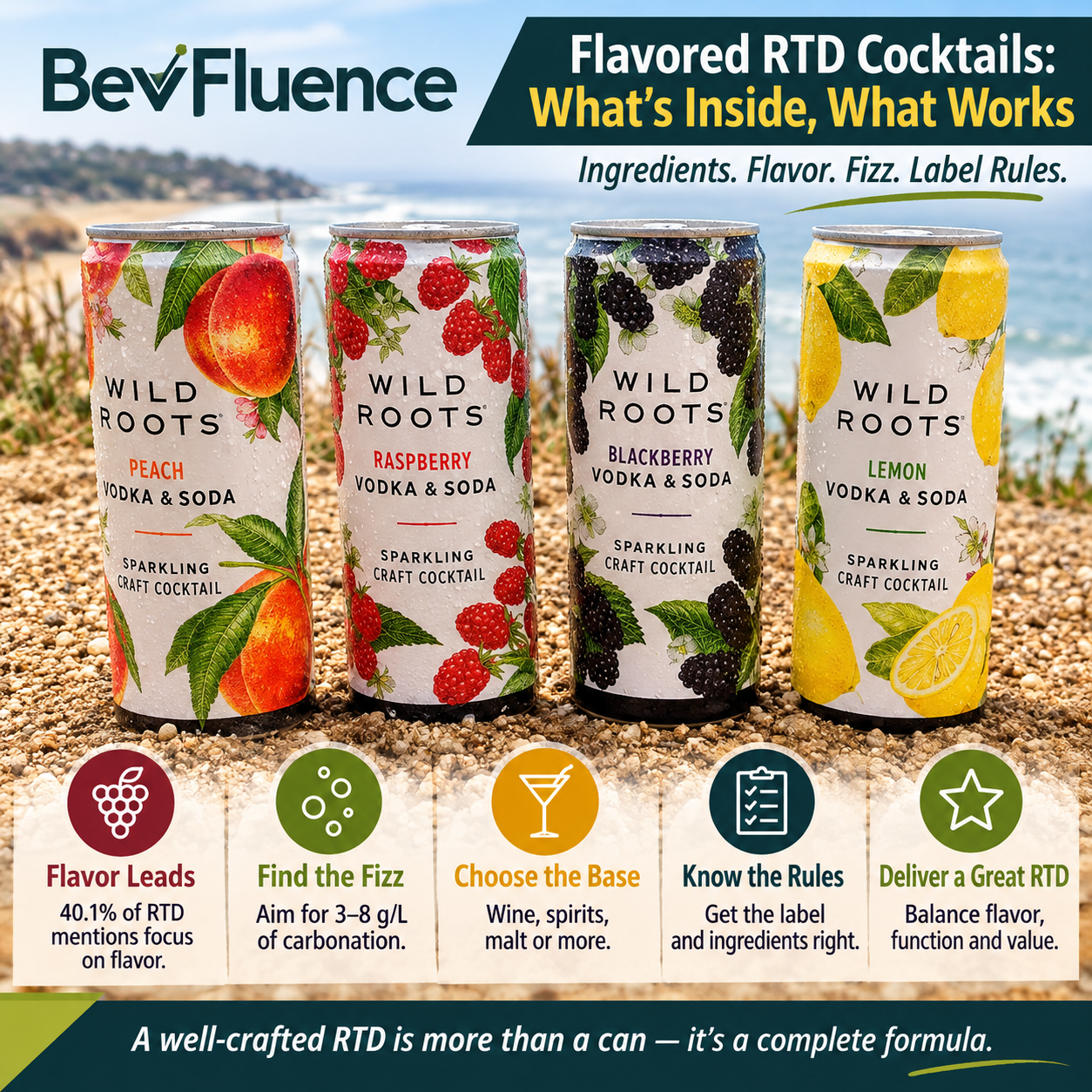
A good RTD cocktail is engineered, not just poured into a can. Flavor is the category’s front door: it drew 40.1% of all functional-driver mentions in Linkfluence’s 2020 study of U.S. RTD conversation. But flavor only works when the base, the bubbles, the preservatives, and the label all work with it.
That’s why the old advice fails. An earlier version of this guide told readers to combine “a can of vodka” with a can of soda. That isn’t how the category works, and it isn’t how winning products are built.
This guide covers what’s actually inside a successful RTD. It draws on FlavorSum’s 2021 formulation e-book, Linkfluence’s social data, Grand View Research, and 2025 competition results. Every number has a named source.
Flavor Is the Front Door
Linkfluence sorted RTD consumer posts by the functional driver they mentioned. Flavors led at 40.1% of mentions, and taste followed at 27.1%. Refreshment took 8.1%, and low calories, carbs, and sugar together took 6.1%.
The smaller drivers still matter. Convenience drew 5.0%, alcohol content 4.8%, and naturality 4.0%. Price and brand know-how each drew 2.5%.
Mentions measure visibility, not love. Linkfluence also scored each driver’s ratio of positive to negative posts. Refreshment scored 12.9, naturality 6.8, and flavors 4.2.
What Drinkers Asked For
Linkfluence found mango, cherry, and lime were summer favorites in the 2019 conversation. Drinkers also asked brands for fall and winter flavors. One post asked White Claw for a pumpkin flavor in August.
Seltzer drinkers and cocktail drinkers wanted different things. Hard seltzer fans valued original, varied fruit flavors. Canned cocktail fans wanted a wider flavor palate.
White Claw’s 2020 additions landed well online, per Linkfluence. The brand announced watermelon, lemon, and tangerine. In its variety pack, black cherry became the fan favorite, which some drinkers called “the Golden Ticket.”
The Variety Pack as a Flavor Tool
Linkfluence credits White Claw’s early salience to its flavor range and sleek positioning. Flavor mentions indexed at 114 for White Claw, against an average of 100. Drinkers loved simple, minimalist exotic flavors, with mango on top.
The variety pack did extra work. Linkfluence calls it a playful format that created a sense of exclusivity and surprise. Both are essential for creating buzz.
That’s a lesson in flavor strategy, not just packaging. A variety pack lets drinkers find a favorite without risking a full case. It also tells the brand which flavor deserves its own pack.
What the Launch Data Shows
FlavorSum cites Mintel’s Global New Products Database for North America from 2018 to 2020. Just 15 single flavors accounted for 42% of flavored alcoholic beverage launches. The top three were grapefruit at 6.1%, lime at 5.4%, and mango at 4.9%.
The rest of the top 15 ran tight. Black cherry took 3.4%, lemon and lime 2.7%, and pineapple 2.5%. Lemon took 2.2%, and peach, strawberry, and watermelon each took 2.0%.
Cranberry, raspberry, and wild berry each took 1.8%. Lemonade and blood orange each took 1.6%. That’s a crowded shelf built on a short list of fruit.
Blends Are the Real Growth
FlavorSum reports flavor blends like pineapple-coconut or strawberry-guava made up 50% of new flavored alcohols. Blends grew 45% in 2020. Producers turned to blends to keep drinkers interested.
Grand View Research points the same direction. It names RTD cocktails infused with ginger, rose, and lavender as part of the category’s appeal. It lists lemon, cranberry, orange, and passion fruit as common added flavors.
The takeaway is simple. A single citrus note won’t stand out on a shelf where grapefruit and lime already lead. A specific blend gives a drinker a reason to pick your can.
Flavor Follows the Base
FlavorSum broke North American 2018–2020 launches down by alcohol base. Each base has its own flavor lane:
- Wine-based: wine with no added flavor led at 12%, then grapefruit at 11%, lemon or lemonade at 9%, and peach at 9%.
- Vodka-based: grapefruit led at 10%, then lime and mango at 9% each.
- Tequila-based: lime dominated at 28%, followed by grapefruit at 17%.
- Rum-based: pineapple-coconut and watermelon tied at 16%, with cola or root beer, lemonade, and lime or mojito at 11% each.
- Gin-based: gin and tonic led at 29%, then gin and lime at 18%, and cucumber at 12%.
- Whiskey-based: launches were single entries, including chocolate and cream, coffee and orange, and honey, tea, and chai.
Wine’s Flavor Opening
Brager’s January 2026 presentation shows the RTD aisle under one banner: “Flavors, Flavors, Flavors – All Around Us.” His next slide is titled “Wine and Flavors Co-Existing.” Wine doesn’t have to pick between its identity and flavor.
Grand View notes wine-based RTD cocktails usually include fruit juices like grapefruit, orange, lemon, mango, and berries. It calls malt-based cocktails sweeter, without a well-defined taste. That’s a quality gap wine can use.
Thach’s 2026 recommendations get specific. She suggests wine cocktails built with ginger, passionfruit, tarragon, or rooibos. She also reports Gen Z and Millennials show strong preferences for Moscato, dry rosé, and off-dry or sweet rosé.
The Seasonal Gap and the Trend Pipeline
FlavorSum flags a clear gap. RTD flavors mostly showcase spring and summer. Fall and winter limited-time flavors are harder to plan, but FlavorSum names them as an opening.
Its examples are specific: apple-cinnamon-vanilla and pumpkin-spice-vanilla. Linkfluence’s pumpkin request from 2019 shows drinkers asked for exactly that. Few brands answered.
FlavorSum also compares RTDs to the ice cream category. Both can pull flavors from simply sweet to bright, spicy, nostalgic, or indulgent. That gives brands a wide range to work with.
Where New Flavors Come From
FlavorSum points to the Specialty Food Association’s Fancy Food Show as an early signal. In 2015, the show featured florals and maple, now common in launches. In 2017, ginger and banana went mainstream.
The 2019 show highlighted goldenberries, calamansi, and butterfly pea flower. FlavorSum calls these emerging flavors for brands with a trendier story. They’re also a way to step off the grapefruit-and-lime shelf.
FlavorSum adds a wine idea for brewers and distillers: terroir. Hop terroir for flavored malt beverages or fruit varietals for neutral-spirit drinks can add credibility. It’s a story most RTDs don’t tell.
Clean-Label Signals Drinkers Notice
Linkfluence found drinkers loved “guiltless” drinks without artificial flavors, added chemicals, or preservatives. The gluten-free claim reinforced perceptions of naturality, and not just for the gluten-intolerant. Naturality scored a positive-to-negative ratio of 6.8.
Millennials pushed hardest on ingredients. Linkfluence reports their taste and quality talk centered on real and natural ingredients. They called these “better for them” drinks.
Canned wine drinkers held a high bar too. Linkfluence found they were demanding about naturality, know-how, and taste, and looked for premium products. Within canned wine refreshment talk, rosé was the clear winner, mentioned by nearly 45% of consumers.
Choose the Base Before the Flavor
FlavorSum’s core advice is to answer one question first. What type of RTD cocktail, if any, fits the company’s strategy? That means checking portfolio fit, appeal to current customers, and whether the product builds the main brand or a sub-brand.
FlavorSum lists four guardrails for that conversation:
- How much will style matter in the RTD offering?
- What matters more to the brand story and target consumer: process, flavor, or both?
- What’s the ABV goal?
- What role does functionality play in the product line?
Mass-market appeal often comes from a simpler, flavor-focused process, per FlavorSum. Craft brands care about taste too. But for craft, the method behind the RTD often carries the brand’s values.
The Base Options
FlavorSum walks through each base and its trade-offs. A fermented sugar base from beet, corn, or cane gives a clear, neutral seltzer base that’s gluten-free. Sugar and carbohydrates, roughly one to two grams per 12 fluid ounces, add calories.
A malt base adds a beer taste. Many craft brewers combine malt with fruit, spices, or oak to build a flavored malt beverage that fits their brand. Like sugar, malt adds calories beyond the alcohol.
Grain neutral spirits come from fermenting and distilling corn, wheat, barley, or rye. FlavorSum calls them a faster path to market, because producers can finish a clean beverage within 24 hours. They add water, carbonation, and flavor to the base.
Specialty Bases and Their Costs
Potato and grape neutral alcohols bring their own character. Potato alcohol lends a creamy texture, per FlavorSum. Vinous alcohol carries flavors from grape residue, including pomace solids.
Tequila, gin, rum, and whiskey carry more flavor and color than neutral, sugar, or malt bases. Wine adds flavor, style, and color too. FlavorSum notes vodka was the most popular spirit base for RTD cocktails as of 2021.
Each base changes production, cost of goods, and taste. Neutral alcohol, spirits, and wine production requires a distilling license and a properly equipped, ventilated facility, because vapor by-products are explosive. Spirit- and wine-based RTDs usually face higher taxes and narrower distribution than sugar or malt bases.
Set the ABV on Purpose
FlavorSum reports most RTD alcoholic beverages carry 4% to 7% ABV to meet calorie expectations. Higher-strength seltzers entered at 8% to 14% ABV. Low-alcohol launches have emerged at 2% to 3.7% ABV for drinkers who want more control or follow the sober curious movement.
Grand View’s range lines up. It puts typical RTD cocktail strength at 4% to 7% ABV. It ties low-ABV demand to health-conscious drinkers.
Linkfluence’s social data shows why the choice matters. Alcohol content drew a high engagement ratio of 127.6 interactions per post. Only low-calorie, low-carb, and low-sugar talk scored higher, at 148.8.
Both Ends of the Dial Work
Linkfluence found drinkers split on strength. Many liked the typical 5% ABV of hard seltzer because it let them avoid heavier drinks. Some said it was too low, then mixed seltzer with liquor or switched drinks.
The high end has fans too. Linkfluence names Buzz Ballz as an engaging canned cocktail brand thanks to its high ABV. In the same section, one drinker celebrated buying a 12% ABV canned wine.
Some drinkers want flexibility above all. Linkfluence found people chose lower-alcohol RTDs so they could mix them or drink them alone, depending on the moment. Pick the occasion first, then set the ABV to fit it.
The 2021 deal market rewarded lighter specs. Cascadia Capital describes Canteen Spirits’ vodka and tequila RTDs as low-carb, low-ABV, and zero-sugar with natural flavors. It credits SoCIAL LITE with launching the first unsweetened pre-mixed vodka soda.
Carbonation: How Much Fizz
FlavorSum lays out why carbonation matters. Bubbles create a pleasant tingle on the tongue. Carbon dioxide mixes with water to form carbonic acid, which adds a slightly acidic bite.
Bubbles also lift aroma. They carry aroma molecules up to the nose, which intensifies flavor perception. That’s three sensory jobs from one ingredient.
Measurement trips up new producers. Container pressure reads in pounds per square inch. Liquid carbonation is measured in volumes or grams per liter.
The Numbers to Know
FlavorSum gives a starting point for seltzers of about three volumes, or six grams per liter. For context, sparkling waters run five to seven grams per liter. Sparkling wines run as high as nine, and Champagne runs 12 or more.
RTD cocktails can start as low as three grams per liter. FlavorSum suggests going up to eight, with 10 as an upper limit. To convert grams per liter to volumes, use a 1.96 conversion factor.
Two rules change the math. Carbon dioxide dissolves more in alcohol, so you need more of it to get the same tingle as a water-based drink. Sugar clings to carbon dioxide, so more carbonation makes a drink taste less sweet.
Testing and Equipment
FlavorSum calls applications testing essential. It’s how producers balance sweetness, acidity, flavor, alcohol, and carbonation. Carbonation level should reflect the base, the target taste, and the brand image.
Fermentation adds some natural carbonation. Many producers also use forced carbon dioxide bottles or pressurized systems. FlavorSum notes in-line systems now come in smaller footprints for small and mid-sized producers.
Not every RTD needs bubbles. Cascadia Capital reports non-carbonated RTDs grew fast in 2021. Many drinkers dislike the bloated feeling that comes with carbonated drinks.
Inside the Formula
FlavorSum offers a formula illustration for a flavored RTD. Sugar runs 8 to 11 Brix, and alcohol runs 5% to 9%. Flavor runs 0.25% to 1%, and color runs 0.2% to 0.5%.
Preservative sits above 300 parts per million. Water and a set carbon dioxide level complete the formula. It’s a framework, not a recipe.
Preservation gets harder as alcohol drops. FlavorSum notes lower-ABV drinks need additional preservatives to hold shelf life and quality. Sodium benzoate is added to RTDs unless the process includes tunnel pasteurizing.
Why Producers Use Added Flavors
Natural acids like citric acid can pair with a vinegar or shrub-style drink. But FlavorSum says preservatives stay essential in low-ABV products unless they’re bottle-fermented. Shelf stability isn’t optional.
FlavorSum lists the advantages of added flavors. They give more accurate, consistent dosing and a steady supply. They make unique tastes and blends easier to customize.
They also fit easily into brewing or distilling. They lower safety and contamination risks. And they reduce volume loss in RTDs and flavored malt beverages, which FlavorSum counts as a sustainability benefit.
Where Added Flavors Fall Short
Flavors can replace or replicate alcohol notes when the base is grain neutral spirits. That’s useful for a cocktail-style drink built on a clean base. It’s also where shortcuts show.
FlavorSum warns that matching the robustness of a raw ingredient is hard without a capable supplier. Linkfluence’s complaint data shows what happens when it fails. Drinkers called out drinks that were too sweet or tasted of the can.
Those complaints have fixes. Sweetness, acidity, and carbonation can be tuned in testing. Drinkers in Linkfluence’s data blamed the can itself for metallic notes, so package checks belong in testing too.
The Label Rules That Decide What Ships
FlavorSum names the regulators. In the U.S., the Alcohol and Tobacco Tax and Trade Bureau approves alcoholic beverages. The Food and Drug Administration oversees flavor use through Title 21 of the Code of Federal Regulations.
Canada has its own framework. Health Canada regulates alcohol under the Food and Drugs Act and the Food and Drug Regulations. The Safe Food for Canadians Act and its regulations also apply.
Traditional processes usually don’t need a formula submission, per FlavorSum. That covers pasteurization, filtration, lagering, carbonation, and blending. Adding flavors, filtering to change color, or concentrating does need one.
What a Formula Application Needs
FlavorSum says a U.S. formula with added flavors needs a Flavor Ingredient Data Sheet. That sheet lists:
- The flavor manufacturer.
- The flavor name and TTB drawback number.
- The alcohol content.
- The natural or artificial labeling designation.
- The maximum usage rate, which reflects ingredients like vanillin, caffeine, maltol, propylene glycol, and preservatives.
Regulators can ask for more. Imports above 7% ABV, alcohol-free malt beverages, and other case-by-case products can require lab analysis and samples. A drink with fruit juice or another multi-part ingredient needs an Ingredient Specification Sheet.
What the Front Label Can Say
FlavorSum gives a clear front-of-pack example. If your RTD references a Moscow Mule, the label reads as vodka with ginger and lime, natural flavors, and carbonation. The cocktail name alone doesn’t carry the label.
Some ingredients must be called out, such as FD&C Yellow 5. Water, sugar, and citric acid don’t need to be noted. FlavorSum recommends working with a developer who knows the rules, because RTDs and flavored malt beverages hit regulatory logjams.
Accuracy Is the Rule
Wine’s label debate runs on the same rails. Thach’s Wine & Wellness data shows 47% of consumers believe wine is high in sugar. She recommends ingredient or nutrition labels and a “no sugar added” claim, but only if it’s true.
That last condition is the rule for every RTD label too. A claim has to match the formula and pass the regulator. Clean-label language sells only when it’s accurate.
Training still matters in 2025. The American Craft Spirits Association’s 2026 yearbook reports its convention ran a TTB Bootcamp on permits, formulas, and labeling. TTB presented it remotely because of federal travel guidance.
Functional Ingredients and Claims
FlavorSum reports functionality beyond lower calories is growing. Brewers are using organic vodka or botanicals like lavender and ginger for perceived benefits. Hard kombucha cocktails offer probiotics, lower sugar, and 6% to 7% ABV.
Coffee is another lane. Cascadia Capital reports La Colombe and MillerCoors created a hard cold brew at 4.2% ABV. Newground Hard Dutch Lattes launched an RTD hard latte at 5% ABV.
FlavorSum’s own survey of North Americans found the top three functions people link to drinks. They’re energy, mood enhancement, and immunity. FlavorSum also warns functional paths add complexity and cost to formulation.
A Product Example: Madre Desert Water
Madre’s 2021 Desert Water sell sheet shows how a functional RTD positions itself. It’s artisanal mezcal and sparkling water at 5% ABV in 355 ml cans. The sheet lists 90 calories and claims no artificial flavors, no added sugars, and gluten-free.
The flavors are specific. Madre lists Original, Grapefruit and Yerba Santa, Mushroom Sage and Honey, and Prickly Pear and Lemon. The mushroom flavor names reishi and chaga mushrooms with honey and sage.
The sheet says the drinks are “infused with adaptogens, herbs and fruits.” That’s a brand claim, and we report it as one. Any functional claim on an alcohol label runs through TTB’s rules on what packaging can highlight.
Cannabis and Bitterness
FlavorSum notes THC, CBD, and cannabis-infused seltzers are emerging in some North American regions. Each carries bitter notes the formula has to manage. Legal status varies by region, and Part 4 covers the consumer data.
FlavorSum’s bitterness fixes apply to many functional ingredients:
- Strip as many terpenes and flavonoids from the extract as possible.
- Choose flavors that surround the bitterness.
- Keep non-active ingredients close to tasteless.
- Avoid low-volume, high-concentration solutions.
- Use a flavor-masking agent, added separately or blended with the extract.
Mixing With RTDs: What Drinkers Actually Do
The old version of this guide offered recipes built on cans of vodka. We cut them, because they don’t match any product we can source. Here’s what the data shows drinkers really do.
Linkfluence found consumers and bartenders mix hard seltzers with vodka, tequila, or juice. Some pair a seltzer with a shot on the side. One drinker mixed mango White Claw with grapefruit juice and lemonade.
A bartender in the data built a drink from orange Smirnoff, orange-vanilla sparkling water, raspberries, and a cherry. Linkfluence’s recommendation follows from that: RTD brands should work with mixologists to show off versatility. Loyalty and versatility were less visible topics, which leaves room to stand out.
The At-Home Bar Raised the Bar
Drizly’s 2020 survey found 52% of respondents made more cocktails at home over three months. And 54% expected to keep mixing at home. Mixers, syrups, and bitters became Drizly’s fastest-growing category.
Zenith, citing Nielsen CGA, reports 40% of U.S. consumers were looking for cocktail kits at the end of 2020. That’s a drinker who wants the craft without the full bar. Zenith also reports mixologist videos on TikTok surged as drinkers looked to create new drinks.
That’s a challenge for RTD brands. A drinker who learned to build a decent margarita at home won’t accept a flat, sweet one in a can. The canned version now competes with the drinker’s own skills.
Linkfluence saw quality surprise drinkers in the other direction too. One drinker said they’d been “blown away” by the quality of premixed cocktails. Another called a canned spirits gin and tonic the best they’d had.
What Wins: Competition and Category Standards
The American Craft Spirits Association’s 2026 yearbook names 2025 RTD winners. At the 11th American Craft Spirits Competition, Strubarb Pie from Backwards Distilling Co. in Wyoming took Best of Class for RTD. At the fifth Craft Spirits Packaging Awards, The Martini from Hoste Cocktails in Illinois took the RTD gold.
The same convention ran a session called “Production of RTD Beverages.” Phil Markowski of Two Roads Brewing led it. ACSA lists it among the best-attended sessions.
That’s the craft spirits world treating RTDs as a production discipline. It’s not a side project anymore. It has its own medals and its own technical track.
Will RTDs Get Style Guidelines?
FlavorSum asks whether a body like the Beer Judge Certification Program will set RTD styles. It suggests style lines like these:
- Sweet or dry.
- Low, average, or high ABV.
- Sparkling or still.
- Functional or basic.
FlavorSum expects the category to settle into standards shaped by what succeeds in market. Regulators may also set firmer development rules. Until then, brands build their own guardrails. FlavorSum’s take is that the category’s mix of bases, tax rates, packages, and label rules could restructure the alcohol market.
The RTD Build Checklist
Brager’s January 2026 slide sums up the RTD pitch in four words: flavors, format, function, and financial. The last one means price per unit. A build that ignores any of the four leaves an opening for a competitor.
Here’s the sequence the sources support. It doesn’t guarantee a hit. It removes the most common reasons RTDs fail.
- Strategy first: decide portfolio fit, brand role, ABV goal, and functional role before formulating.
- Base second: weigh taste, tax, licensing, and grocery access for sugar, malt, neutral spirits, spirits, or wine.
- Flavor third: look past the top-15 fruit list toward blends, seasonal flavors, and origin stories.
- Carbonation fourth: set a target in grams per liter, then adjust for alcohol and sweetness.
- Label fifth: prepare flavor data sheets, spec sheets, and front-label language before launch.
- Test last, and test again: check for excess sweetness and metallic notes, the top complaints in the data.
Up Next
Part 3 turns from the can to the drinker. It covers who buys RTDs and when they drink them. It also tests the old gender assumptions against the data.
Next in the series: Part 3, RTD Consumers: Generations, Social Tribes, Occasions, and the Gender Myth.
References
American Craft Spirits Association. (2026). 2026 craft spirits yearbook [Annual yearbook].
Brager, D. (2026, January 28). Consumer demand: At the crossroads [Conference presentation]. Unified General Session, Sacramento, CA, United States.
Cascadia Capital. (2021). Beverage industry market update: Fall 2021 [Market report].
Drizly. (2020). Drizly consumer survey report 2020: Alcohol shopping and attitudes, mid-2020 [Survey report].
FlavorSum. (2021). How to master formulation challenges in the “Wild West” of RTD cocktails: Guidelines for brewers and distillers [E-book].
Grand View Research. (n.d.). Ready to drink cocktails market analysis and segment forecasts to 2028 [Sample report].
Linkfluence. (2020). Hard seltzers, canned wine and canned cocktails: What’s driving the ready-to-drink beverage boom? [Social intelligence report].
Madre. (2021). Madre Desert Water [Product sell sheet].
Thach, L. (2026, January). The pulse of the U.S. wine consumer: Opportunities in 2026 and beyond [Conference presentation]. Wine Market Council, Unified Symposium, Sacramento, CA, United States.
Zenith. (n.d.). Business intelligence – Alcohol: Beer + spirits [Industry report].